Showing posts with label literary musing. Show all posts

Monday, August 22, 2011

And See the Land Where Corals Lie

I can see him walking amid the shadows. He breathes in the heady odours of buckram, Morocco, vellum and calf. There are manuscript pages and a book in his left hand as he walks along humming quietly to himself, thinking of an odd passage from an ancient obscure work, the sheltered light glinting off his spectacles as the dust motes rise and fall invisibly between the bookshelves as he passes.

That is my imaginary vision of Richard Garnett in his lair, the British Museum, a phantom amidst the stacks, shifting books and papers in an endless round.

Ford Madox Ford in one of his many books of biographical and autobiographical impressions described him as "a queer, very tall, lean, untidily bearded Yorkshire figure in its official frock-coat and high hat." I wrote about Richard Garnett not too long ago in a post about
Robert Louis Stevenson, and having recently re-read the above mentioned book of memories and impressions by Ford Madox Ford, the author provides a further dimension to his passing physical description of Dr. Garnett, one which I failed to remember. It would have been apt for my post on Stevenson as it included a reference to umbrellas:

Having a passion for cats, Egyptology, palmistry and astrology, the great scholar could assume some of the aspect of deaf obstinacy that distinguishes cats that do not intend to listen to you. He cast the horoscopes of all his friends and reigning sovereigns; he knew the contents of a hundred thousand books and must have stroked as many thousand "pussies" pronouncing the "pus" to rhyme with "bus." He was inseparable from his umbrella with which he once beat off two thieves, when at five in the morning he had gone to Convent Garden to buy the household fruit. He was the author of the most delightful volume of whimsico-classical stories that was ever written and the organiser of the compilers of the catalogue of the British Museum Library--an achievement that should render him immortal if his Twilight of the Gods fails to do so.

In the older post on Stevenson, I quoted a poem he wrote on the other side of the world in his tropical paradise, thinking of his old friend Sidney Colvin and his visits to Colvin's home attached to the British Museum. I feel I should round off this brief revisit with a poem by Richard Garnett, who in his dusty comfortable haunt, thought of Robert Louis Stevenson in his exotic lotus land and wrote a sonnet about him after the young author died in 1894. It was published in his The Queen and other Poems, 1901:

Robert Louis Stevenson

Wondrous as though a star with twofold light
Should fill a lamp for either hemisphere,
Piercing cold skies with scintillation clear,
And glowing on the sultry Southern night;
Was miracle of him who could unite
Pine and the purple harbour of the deer
With palm-plumed islets that sequestered hear
The far-off wave their zoning coral smite.
Still roars the surf, still bounds the herd, but where
Is one to see and hear and tell again?
As dancers pause on an arrested air
Fail the fast-thronging figures of the brain;
And shapes unshapely in dim lair,
Awaiting ripe vitality in vain.

It is interesting to read the line "the far-off wave their zoning coral smite," for it recalls Richard Garnett's poem Where Corals Lie, written in his youth and published with many other poems in his Io in Egypt and Other Poems, 1859. Edward Elgar used Where Corals Lie in a song cycle, Sea Pictures, Opus 37. Perhaps I should leave this post with a recording of Janet Baker singing the song:


Saturday, July 09, 2011

Inscriptions of Interest, or, Croquet in Winter.

Author signatures and inscriptions seem rather common these days. Behind most title pages there are author tours, book signings, readings, the authorial laying on of hands at book festivals and the blessings of bookshops and libraries. Then again, perhaps it is just a question of scale. Authors in the past no doubt employed their fountain pens just as fervently when faced with pristine fresh printed stacks of hardcover books. Booksellers and bookbuyers, hovering expectantly, no doubt had their moments in time with a celebrated author. One hopes.

Placement of signatures and inscriptions vary like styles. Front free endpapers, title pages, half-title pages, dedication pages have all been used by authors. I find when authors strike out their printed name on the title page and then inscribe their signature beneath in flowing liquid ink, it is rather like an act of existential defiance, as if reclaiming identity from the machine and its machine ways. Authors who hide their signatures on half-title pages intrigue me. Those who go further inland and lay their touch on dedication pages may well have something of the trickster about them. The front free endpaper, however, does not bode well as a place for signing. Too vulnerable. Like being left on the stoop in the rain. Perhaps these authors are extrovertedly adventurous and carefree. Motorcycle drivers and fans of the mountain's edge.

The late and multi-talented author Paul Quarrington was fond of playful line drawings to accompany his artistic flourish. That of Alice Munro, simple and straightforward on the title page. William Gibson, large looping flourishes with occasional dots and underlinings on half-titles. The diversity in this realm is fascinating.

I remember a book that was donated to the library I worked for by one of the Molson family. A wonderful older volunteer had worked for the Senator Molson and she was instrumental in getting book donations from his sons. This book on the Montreal Canadians was a birthday gift and it was signed by all the great Montreal Canadian hockey players, Béliveau, Richard, Cournoyer, Lemaire, and on and on, and each signature revealed exquisite penmanship. Catholic schools of the day truly taught fine penmanship. Through the volunteer I inquired whether it was mistaken donation, such a personal gift that it was, but I was told that he had many other items and it was not a mistake. I had hoped the Library would use it for a fundraising item, but having left the library I don't know of its fate. But certainly an interesting inscribed volume.

Inscriptions and association copies are always of interest, even from lesser known and forgotten authors. It is humbling to come across an author whose work, for the most part, has been swept into the vast dusty penumbra of pen wielders. Authors who scratched away for years forming sentences and paragraphs, methodically building a body of work, a list of titles, letter by letter, creating a name and reputation which they hoped would have some lasting value, only to slip into the dark shadows of disinterest, and perhaps be only vaguely remembered for a best-selling and unworthy volume.

Moray McLaren (1901-1971) was unknown to me when I picked up three of his books in Montreal many years ago. In doing a bit of research on the author in those pre-internet days, I didn't come up with much. Even now I can't say I have enlarged on my knowledge. There is a such a thin veil of information about the author and his books, the questioning mind begins to wonder why. I am sure most booksellers know of the name and some of the titles, and probably have one or two in stock, but he seems to be one of those authors of his period--one of many perhaps--who is no longer relevant. His books are certainly available for purchase on various bookselling sites but in such great quantities--over 700 volumes on ABE-- that I could possibly conclude that the value of his writings was transitory, the works of their time and place.

He was to a certain degree, a younger contemporary with Compton Mackenzie (1883-1972), and he wrote an address for Mackenzie's eightieth birthday at a gathering at the Scottish Arts Club in Edinburgh. This was later published as a booklet of a few dozen pages: Compton Mackenzie: A Panegyric for his Eightieth Birthday (Edinburgh: Macdonald, 1963).

Dipping into his Stern and Wild: A New Scottish Journey (London: Chapman & Hall, 1948), I found him to be a good stylist, though perhaps dated in his attitudes, the following quote being one example: The one-man business of being a writer has been described as one of the only two professions that can be practised in bed. This is not strictly true. Writing in bed is possible but uncomfortable. (p. 26). Sounds like a joke from Jimmy Carr.

He was born in Edinburgh in 1901 and went to Corpus Christi, Cambridge for his degree. He was an assistant editor of The London Mercury, and The Listener, and was also with the BBC radio service, Scottish region where he wrote plays and broadcast talks. His involvement with the British Foreign Office during WWII led to his being in charge of the Polish Political Institute during the war years.

So he was a Scot who went south for his education and employment and ended up being a freelance writer after the war and garnering an OBE into the bargain. His Scottish brethren might have looked askance at his involvement with the English milieu, but he, like Compton Mackenzie, was a devoted Scot, writing many books on the subject. His first book, Return to Scotland: An Egoist's Journey (Duckworth, 1930) being the first of many. His second book, A Wayfarer in Poland (Methuen, 1934), must have led to his being appointed to the Polish Political Institute. I can imagine the conversations of Foreign Office types, wondering what chap could fill the position, and someone piping up with a tidbit about a friend of theirs having written a book about the country a few years ago. Good enough, sign him up. Images of Evelyn Waugh's William Boot in Scoop come to mind. Poland in the early 1930s, I can only imagine what he wrote. No doubt dated.

Two books of fiction followed after the war, a collection of short stories based on his radio work, A Dinner With the Dead and other Stories (Edinburgh: Serif Books, 1947), and a novel, Escape and Return (London: Chapman & Hall, 1947). This novel is described by Robert Eldridge as: "a dark portrait of an alcoholic writer in wartime Britain and his perilous recovery, all the more forceful for its lack of temperance moralizing or sensationalism. The first half is set in London, the second in Scotland, where the protagonist recovers with the help of sympathetic doctors and priests, finally regaining his Catholic faith along with his sobriety. The story contains hints of Satanic goings-on in London." On the inner flap of the dustwrapper this description is provided: "It is the story, in modern life, of demoniac possession and exorcism, rendered all the more striking for the fidelity with which the scene is constructed, lower Bohemian London during the air raids, a world of black magic, illicit drinking, war-weariness and work-weariness." Sounds like a book Colin Wilson might have read and enjoyed.

I have yet to dip into either of these books of fiction. Life is short. The novel, Escape and Return, however, has an inscription of interest and holds a certain charm. Located on the front free endpaper, and written in a fine hand with dark ink somewhat faded with time, the 46 year old author wrote the following:

Thank you for buying this book. You are the first who (as far as I know) has done so. I hope you won't be the last.
Moray McLaren.

Considering that Moray McLaren did not continue writing fiction, I imagine his sales were not promising. Non-fiction became his area of concentration, mainly popular biographies and histories, books on fishing and wine as well, along with basic newspaper and magazine work.

His inscription in his first and only novel, is one that every author hopes will prove true. For some authors, however, trying to sell fiction is like playing croquet in the snow.


Addendum: Having only dipped into one of his books, I don't want to sound unkind in my judgements of his work. He may very well have been an excellent writer, friend, and associate to the many who knew him. It is also quite likely he was damn good at winter croquet.

Books by Moray McLaren:
Escape and Return, Chapman & Hall, 1947.
A Dinner With the Dead (stories), Serif Books, 1947.
Stern and Wild: A New Scottish Journey, Chapman & Hall, 1948.
"By Me...": A Report Upon the Apparent Discovery of Some Working Notes of William Shakespeare in a Sixteenth-Century Book (edited by Raymond Postgate), J. Redington, 1949.
A Small Stir: Letters on the English, Hollis & Carter, 1949.
The Capital of Scotland, Douglas & Foulis, 1950.
(Editor) The House of Neill, 1749-1949, Neill & Co., 1950.
The Capital of Scotland: A Twentieth-Century Contemplation on Edinburgh, Douglas & Foulis, 1950.
Stevenson and Edinburgh: A Centenary Study, Folcroft, 1950.

The Scots, Penguin, 1951.
(Editor of revision) Desmond Campbell Miller, Questions and Answers on Evidence, Sweet & Maxwell, 1951.
A Singing Reel, Hollis & Carter, 1953.
The Highland Jaunt: A Study of James Boswell and Samuel Johnson Upon Their Highland and Hebridean Tour of 1773, Jarrolds, 1954, W. Sloane, 1955.
Scotland in Colour, Batsford, 1954.
Understanding the Scots: A Guide for South Britons and Other Foreigners, Muller, 1956.

Lord Lovat of the '45: The End of an Old Song, Jarrolds, 1957.
The Pursuit, Jarrolds, 1959.
Fishing as We Find It (letters), Stanley Paul, 1960.
The Wisdom of the Scots: A Choice and a Comment, M. Joseph, 1961, St. Martin's, 1962.
If Freedom Fail: Bannockburn, Flodden, the Union, Secker & Warburg, 1964.
The Shell Guide to Scotland (edited by Yorke Crompton), Ebury Press, 1965,

Poland's Thousand Years: The Vanguard of Christendom, Catholic Institute for International Relations, 1965.
Pure Wine; or, In Vino Sanitas: A Centenary Celebration of, Quotation From, and Comment on Dr. Robert Druitt's Remarkable Book, "A Report on Cheap Wines, 1865," A. Campbell, 1965.
Corsica Boswell: Paoli, Johnson, and Freedom, Secker & Warburg, 1966.
Sir Walter Scott: The Man and the Patriot, Heinemann, 1970.
Bonnie Prince Charlie, Saturday Review Press, 1972.
The Fishing Waters of Scotland, J. Murray, 1972.
Scotland, Ebury Press, 1977.

Saturday, September 12, 2009

Yacht Sybarite or, a Minor Bibliographic Digression


Caught by the Nose:
How fortunate for the youth of today to have access to astounding online collections of printed materials. I think of my youth in Montreal and how difficult it was to access books. It was a world of closed stacks and memberships. Much time and effort was required to look at a book--if you could even find the desired volume--and many of the books, due to age, scarcity, and crumbling condition, were for in-library use only. Oh to have been able to browse the Internet Archive when young, and discover scarce books in presentable scans of the original pages and to have been able to read them on a portable device when and wherever I desired. I may have lost myself in such examples as these random choices: Isabella Bird's Among the Tibetans , Ford Madox Ford's The Brown Owl Abydos by W. M. Flinders Petrie, or The Ipane by R. B. Bontine Cunninghame Graham,

As it was, I supplemented my library use with second-hand bookshops and all the major and minor booksales throughout the city. I have many memories of attending sales, and one in particular comes to mind.

In the fall of 1978, I arrived early one Saturday morning for the annual booksale at The Fraser-Hickson Institute, but a few minutes' walk from where I lived. One hour and a half later, 9 a.m., the doors opened and the few of us early bookscouts, pickers and book dealers led the now long line of book fanciers on up to the auditorium. My purchases were always modest. A small box or two depending on the combination of my financial situation, the selection of books for sale, how quick my eye to hand coordination was that morning, and how willing I was to jostle and scrape in the mild scrum that was to ensue. Luck sometimes helped. The book that holds this sale in memory is one which I picked up for a lowly 10 cents, a copy of Virgil's Aeneid translated by John Dryden. It was an edition issued by George Routledge & Sons, full red pebbled leather, raised bands, gilt titles and ruling, marbled endpapers and gilt all round. The half-title and title page were headed "Sir John Lubbock's Hundred Books." A short introduction was initialed "H.M." and dated March 1884. At the time I knew nothing of Lubbock and his list of books. Hadn't a clue who "H. M." was and why they were hiding behind their initials in so old fashioned a way. Since the title page and its verso lacked a publication date, I had to judge the 1884 as an unreliable witness. Finding information in 1978 entailed a bit more time and legwork than today. Reference books had to be sought out. Wooden library catalogue drawers had to be consulted, the stiff cards perused, their corners yellowed by many a thumb and finger. Requesting closed stacks materials was often greeted with heavy sighs, raised eyebrows, head scratching and the occasional "hmm, yes........". "The Pleasures of Reading by Sir John Lubbock, hmm, yes......". "The Life of Sir John Lubbock by Horace G. Hutchinson.......hmm, yes...". Dust had to be disturbed.

It was fairly easy to find out about Sir John Lubbock, one of those extraordinary polymaths of the Victorian period, but to discover bibliographic information about this particular edition of Virgil's Aeneid, was however, a bit more of a challenge. More dust to be disturbed. Consulting those large brown cloth volumes of Bookman's Price Index was painfully tedious and slow, but occasionally they offered up some useful information. Auction records, bibliographies, and periodicals were not as easily available. I seem to remember spending a few moments of time on trying to pin a date on this relatively unimportant volume, a finely bound issue of a standard text in a series initiated by Lubbock's then, influential list. As it was, Lubbock didn't publicly conceive his list of hundred best books until the autumn of 1885, so the 1884 introduction by "H.M." was no doubt from a previous Routledge edition, and brought out to get a piece of the action swirling around the controversy of Sir John Lubbock's One Hundred Books. [An essay on the subject can be found here.] I figured it was published around the 1890s to the turn of the century and left it at that.

The introduction was in fact written by Henry Morley, a prolific editor and writer perhaps best remembered, if at all, for editing the "English Authors" series. He also edited a series of texts called "Morley's Universal Library" which were issued by George Routledge and Sons. Morley must have known Lubbock, or at least, known of him. The London literary milieu must have been fairly tight at that time. However, since Morley died in 1894, it is likely he wasn't alive when the publishers availed themselves of one series introduction for another. Posthumous recompense was unlikely at the time. Publishers had to be versatile, innovative and thrifty; they had to know how to cut their coat according to their cloth to use an old phrase.

John Dryden's publisher, Jacob Tonson, was fairly innovative. Dryden's translations of the works of Virgil were published by Jacob Tonson in July 1697 when Dryden was 66 years of age. The first edition sold out in a few months. Henry Morley's short introduction is very good and he provides a brief bibliographic backcloth:


In modern form there was only John Ogilby's very poor translation of the works of Virgil, which had been first published in 1649, and reproduced in 1654 as a handsome folio, adorned with plates by Hollar, Faithorne, and Lambert. Jacob Tonson, Dryden's publisher used for his edition Ogilby's plates touched up, and published Dryden's Virgil by subscription, engraving under successive plates the arms of one hundred and one subscribers of five guineas, who contributed towards the adornment of the work with engravings; besides these, there were heraldic honours in part payment. The profit from the work to Dryden himself seems to have been about twelve hundred pounds. A generation later Pope earned very much more by translating Homer. As Dryden would not make friendly advance to King William, by dedicating the translation to him, Jacob Tonson, as publisher, did his loyal best by directing that, in retouching the plates, the Roman nose of the pious "Aeneas" should be made to conform to that of William III. And so Tonson hoped that His Majesty might be caught by the nose.


Whether William III was "caught by the nose" is a question for scholars, but I was certainly caught by the nose in that the smell of this volume still infuses me with the initial pleasures of reading Dryden's translation, and makes me remember how his anastrophic sentences and heightened style, were, and still perhaps are, subtle influences upon the way I write a sentence. For quite awhile I carried this volume around with me. Not the most practical edition for such reading. How much more practical are the portable devices to read ebooks today. Not just the Aeneid, but a complete library could be had in one slim device. I can imagine that the batsmen responsible for Napoleon's travelling library might have eased their weary bones with dreams of such magic.

Diversional Voyage:
There is one peculiarity to this 10 cent volume. In the red leather of the upper board are the words "Yacht Sybarite" blind-stamped in gilt. I didn't know what the words signified. Strangely, in my ignorance, it struck me at the time as some kind of Latin phrase. The thought that the book might have been from a collection that once found a home on a yacht called Sybarite occurred to me but to pursue such a tangent seemed as darkly unpromising as Childe Roland's seeking out the Dark Tower. While the gilt letters of 'Yacht Sybarite' figuratively faded from my conscious mind, I went on to enjoy Virgil's narrative and Dryden's vigorous and influential style.

I had quite forgotten about the gilt inscription on the upper board, until this past week, when, doing some casual research related to George Jay Gould, I came across a reference to a yacht named Sybarite. I remembered the book and wondered if there could be a possible connection.

George Jay Gould was the son of Jay Gould, and he inherited much from his father, including the steam yacht, Atalanta, originally built for his father and launched in Philadelphia in 1883. The New York Times reported in July 1900 that George Jay Gould was selling The Atalanta to the Government of Columbia where it would be converted into a gunboat. It was later revealed that the South American country was in fact, Venezuela. So, George Jay Gould, an active member of The Atlantic Yachting Club during a period that was a golden age of yachting--he was their Commodore in the 1890s--was in the market for a new steam yacht.

Almost one year later, June 1901, the New York Times reported the he had purchased a 924 ton steam yacht with a water-line measurement of 220 feet. It was originally built for Lord Ashburton in 1893 and named Venetia. Lord Ashburton sold it but a few years later in 1897 to Whitaker Wright. The New York Times mentioned that Wright had renamed it the Sybarite. It was in London, in December 1900, that Whitaker Wright's financial empire collapsed and he was first accused of misuse of investment money. A good overview of the scandal can be found here. His sale of the Sybarite to Gould six months later is telling.

[A few odd facts: George Gould's daughter, Edith Gould, was born on the Sybarite in 1901. George Gould's wife, the former Edith M. Kingdon, died in 1921 of a heart attack on the golf course of their estate in Lakewood, New Jersey. Doctors discovered she had used a rubber body suit from neck to ankle to maintain her figure. Since George married his mistress not long after and acknowledged his illegitmate children, one wonders at the pressures Mrs. Gould suffered. And then George Jay Gould died of pnemonia on May 16, 1923 on the Riviera after having visited the tomb of Tutankhamun and contracted a fever. This no doubt helped to fuel the concept of the Mummy's curse since Lord Carnarvon had died on April 5, 1923 in Cairo. For all I know, George Gould could have been reading this very copy while visiting Egypt in 1923. It would make for good dinner conversation at least.]

So, from these few scraps of information from very casual research, I could possibly conclude that this volume of Virgil's Aeneid, was part of the library aboard the yacht Sybarite, a collection that probably contained the complete Hundred Best Books as listed by Sir John Lubbock, all bound in uniform red leather with gilt edges all round, and all with the blind-stamped gilt words on the upper board, "Yacht Sybarite." It seems likely, considering Wright's proclivity to excess that it was he who ordered such a collection for his yacht, though I can't rule out the possibility that the books came with the ship and Wright had them blind-stamped in gilt to show ownership.

The answer to the question of how the volume ended up in a library sale in Montreal in 1978 seems to live in the realm of speculation. Books have lives of their own. Most outlive us. They can pass through many hands and reside on many shelves in their lifetime. This Aeneid is an orphan in a way, a stray from a larger collection. More the rule than the exception since so many book collections are sold off at some time and dispersed among various owners. Most likely, when the Sybarite was sold or broken up, the library too was broken up and auctioned off. Or perhaps the collection was passed down through the family. Perhaps there is a descendant of George J. Gould who this very day is sitting in their library wondering where that hundredth volume in that collection had gone and how. Perhaps it was a guest who availed themselves of the library for some bedtime reading and their servant inadvertently packed the volume in the luggage upon leaving. Perhaps it was with George J. Gould as he passed away in the Riviera, and was misplaced in the aftermath of his death. Any manner of stories could be conjured up. Any one of them as likely as the next.

An ebook reading device will never enjoy a long and diverse provenance like that of old bound volumes, but these devices allow us to connect with books that do have interesting backgrounds. To be able to peruse old library volumes from the comfort of our homes is an extraordinary accomplishment. Library stamps, librarian's pencil annotations and call numbers, creases, foxing, markings in the text and marginalia are revelations of the books character. I can see how many will find ebook devices perfect for reading the latest bestseller, but I tend to see them as devices to explore the closed stacks of great libraries.

Considering the death of George J. Gould, perhaps a little archaeology concerning Howard Carter and Lord Carnavon.

Wednesday, June 17, 2009

The Pleasures and Sorrows of Work by Alain de Botton

The Pleasures and Sorrows of Work by Alain de Botton (McClelland & Stewart) black/white photographs by Richard Baker, 327pp.

My initial impression of this book was its weight. This Canadian edition is a smaller format book, so it is surprising to the senses when one first picks it up. It is due to the selection of heavier weight paper which has been used to accommodate the black and white photographs which accompany the text, photographs taken by Richard Baker. Holding the book made me think that weight is perhaps an appropriate metaphor for work itself. Images of Atlas or Sisyphus came to mind, representative precursors of the daily grind.

Alain de Botton writes that he was inspired to embark on this book by his observation of shipspotters on a pier in London. Perhaps there is a source of irony there, for the casual passerby, noticing strange individuals hanging about a pier with binoculars, would probably think they were jobless and had time on their hands. Either that, or eccentric retired folks with time on their hands. Perhaps the more imaginative would wonder if they were sailors waiting for a ship, and think wistfully of sails and the open sea. But Alain de Botton was truly inspired by their fascination with what most of us ignore.

In his essay on Accountancy, he shadows an accountant rising from their home in the Berkshires and catching the commuter train to London, and follows them through a day at the office of one of the world's major accountancy firms. He writes:


The headquarters on the bank of the Thames is the setting for a range of behaviours at least as peculiar as anything that an ethnographer might uncover among the clans of Samoa. (p. 231)


This is perhaps the thought that governs his work, for everything we do as humans, whether we are a tribe of accountants in an air-conditioned tower, tuna fishermen off the coast of the Maldives, or a single artist in a field wielding a paint brush, human endeavour is rich in consideration.

The Pleasures and Sorrows of Work is a book with wonderful writing, sharp insights, wry humour, and thoughtful philosophical musings. Whether it is about biscuit manufacture, pylon towers, accountancy, career counselling, or the craft of painting a single 250 year old oak tree over and over, Alain de Botton uses his wonderfully lucid mind and masterly writing skills to make us see life about us in a fresh and invigorating way, and makes us mindful of the interconnectedness of humans. There is a tinge of stoic melancholy about his conclusions of the necessity and importance of work, and a poignancy that for most of us, fulfillment and happiness are not to be found in our working lives.


Alain de Botton is travelling the world promoting the book. If that's not work, I don't know what is. Here is a link to a video of one of his lectures.

And here is a shorter video of a conversation with Will Hearst.

And for the curious, the room where some of the work gets done, Alain de Botton's room.

Monday, September 15, 2008

Sail on the Horizon: Reading Virgil Burnett's Scarbo Edge: a Romaunt

Scarbo Edge: a Romaunt by Virgil Burnett / with illustrations by the author (Blaurock Press, 2008).

About six pages into Scarbo Edge: a romaunt, an intuitive presumption of familiarity stilled my reading eyes. . . first chapter called 'The Golden Ampersand' . . . night train from Paris to Venice . . . a passionate tryst . . . . . . Venice . . . an erotic assignation. In a visual sense, these would be the first shadowy crosshatchings of my interaction with the text--one reading over another, a memory rising up from the shadows--from the past.

This evocative novel's first chapter appeared--I finally remembered--in a literary journal, an issue devoted to Venice. Not able to remember the specific journal, I did remember the cover image, a rather distinctive animal-faced Venetian door-knocker, and it was by this remembered image that I was able to trace the journal among my wife's collection: Descant, 128, Spring 2005. Looking at it now, I am fascinated by the eyes of this creature which seem almost alive with a sad resignation, as if weary of but another visitor wishing to gain entry, but another soul announcing their arrival. Within this same issue, there is a portfolio of photographs taken by the author when he was in Venice in the late 1950s--France and Italy being an annual pilgrimage for this artist/author. These photographs reveal a city of locals going about their business, a city that had yet to see the inundation of 'tourists' much bemoaned by present day writers such as Javier Marias in a fairly recent article. Perhaps the eyes of this creature reflect the present rise of landfalls and departures--the weight of the worlds' footsteps vibrating through the lagoons.

It is a city in which we find our idealistic hero Eber and his singular love, Isa, secretly celebrating their relationship. Eber, many years ago, met Isa when they were in architecture school, he three years her senior. They began an affair which was casual, non-possessive, modern. When Eber took a position with Marcus Associates he travelled widely and yet he always returned to renew his love with Isa. Disillusioned with Marcus' emphasis on making money and developing properties rather than creating innovative architecture, Eber resigned and travelled the world in an attempt to realign his life. Being an excellent draughtsman, he found work with archaeologists on Iron-age Celtic sites from Malta to Brittany to Cornwall. Years pass. He discovers that Isa has married Marcus, a loveless marriage of convenience. After their tryst in Venice and some attempts to cure his singular obsession, Eber returns to Canada, renting a somewhat run-down Victorian pile called Scarbo Edge on the rough coast of Lake Huron not far from Falaise, Marcus' mansion where Eber has discovered Isa resides. And so their relationship is renewed, fraught with dangers from the present, and possibly mirrored in the past.


Scarbo Edge is not only a variation on the Tristan and Isolde legend--the eternal love triangle, that triadic template for much of the Western narrative tradition from the Iliad on--but it incorporates a variation of the suspense genre as well. It is both an old story and a new one. It is a story of passionate physical love, of eroticism, of singular desire. A narrative richly veined with allusions and ambiguities, dualities and duplicities, ghostly parallels, existential wanderings, and mythic ordeals.

Virgil Burnett, artist and author, is a master of the line--'proportion, anatomy, and composition'-- and this mastery, informed by a wealth of experience and knowledge, finds its equivalence in his written word . His style is one of a born story-teller, both simply told and beautifully written. His descriptions of the physical relationship of a man and a woman is both exquisitely poetic, and vigorously real. A rich addition to Virgil Burnett's diverse oeuvre.

Sunday, August 31, 2008

Two from the Porcupine's Quill

A Wood Engraver's Alphabet by G. Brender à Brandis (Porcupine's Quill, 2008).

Prompted by Tim Inkster of Porcupine's Quill Press, Gerard Brender à Brandis, master engraver and print maker, has produced another wondrous book of wood-cut engravings, a flower for each letter of the alphabet.

The engravings are so rich, so densely cut, that looking closely at the engravings one feels drawn into the pictures as if entering a forest, a forest of detail. Coming to the Foxglove, I felt as if I had entered a clearing and there stood the flower, totemic in its beauty.

In his introduction, the artist reveals something of the process of engraving--conceptions and methods--much like he so affably does when one visits his "Artist At Work" open gallery and workshop in Stratford, Ontario, during the Shakespeare Theatre season.
Although a book of silent images, he reminds us of how flowers were used as messengers of unspoken meanings, and so the alphabet, the text--sub rosa-- can be woven within these images for each of us, with our own associations.

A volume to sit alongside the other finely produced books of this artist issued by the Porcupine's Quill, and a book, by all means, for the gardener's or horticulturist's collection. An ideal gift in fact.


Off the Wall drawings by Tony Urquhart with Captions Courageous by Michael B. Phillips (Porcupine's Quill Press, 2008).

Though admittedly not thoroughly familiar with the work of this artist--only vaguely so in the shadows of my knowledge--I found this most unusual book to be most entertainingly amusing. I was surprised in a most pleasant way for I had approached this volume in all seriousness, thinking I should first look closely at all of Urquhart's images before embarking upon the textual commentary by Michael B. Phillips, realising that I may be entering the rather dubious territory of tertiary discourse: the artist's work, the associate's commentary on that work, and then my observations of the work and reactions to the commentaries, a rather dour academic endeavour fit for the post-graduate in art history. . . .

I guess I should have clued in to the title: "Off the Wall" and "Captions Courageous."

The commentaries, or rightly so, 'captions', are as imaginative, absurd, humourous and surreal as some of the drawings, prints and sculptures that grace the pages of this finely produced volume.

My initial observations evoked images of pedestalled personal altars, cosmological or climatological devices, strange reliquaries, bizarre, surreal--à la Remedios Varo--objects with organic links between the terrestrial and the cosmological space-time continuum. . . So how refreshing to come across Phillips's courageous captions such as this one on page 52:

A box inspired by the Spanish puppeteer Senor Sergiao Wenches, a frequent guest on the Ed Sullivan Show. Any resemblance of the head-like object within the box to a former Prime Minister of Canada, or to Ed Sullivan himself, is probably a coincidence.

The image itself is listed in the index as: A forgotten trip. Pen & ink, white gouache, 1977-1983. 14.8cm x 11.4 cm.

I am in awe of their dual imaginations seemingly open to all wave lengths. A very interesting book.


Thursday, June 19, 2008

K is for Kafka--who else could it be?

If asked by a professional in the area of psychology what would first come to mind when shown the letter "K" on a flash card, mine would be an immediate response--and a telling one: Kafka.

Who else could it be?

If asked for other choices, there would be contenders. Kierkegaard is in the shadows, neither in, nor out. Kleist with a ghost-like whisper, is a possibility if pressed. Keats even. But all are in the shadows, so to speak, of Franz Kafka and his Josef K., whose very existence and literary work inhabit the letter, indelibly--at least for me.

I realise it reflects my culture, my judeo-christian background, my literary interests, my education--my alphabet. For others, the letter, or its equivalent, would have a kaleidoscopic variety of responses, from Kiev to K-Mart, from Kilt to Kangaroo, from Kalamazoo to Kathmandu, from Kandahar to Kuala lumpur, from Kawabata to Kurosawa, from Kinshasa to Kansas, from Koontz to King. . . . Other perceptions, other preoccupations, other permutations, other possibilities of this world's rich variety.

Monday, August 27, 2007

G is for Gorey, Genji, Gotham, Grim!

My Dearest Pepys,

We've enjoyed your recent Homeric related letters at Postman's Horn, but glad you threw in a Thurber and that recent Chatwin. My dear wife says--and I agree with her--that you ought to find more women correspondents, though I understand your difficulties for I do realize that your collection is heavy on the male side. Yes, sorry, an unfortunate and unintended pun. My apologies. I shall keep my eye out for books of correspondence by women authors and send them your way.

I have recently been reading a book mentioned by you over at the Horn, The Life and Letters of Lord Macaulay written by Sir George Otto Trevelyan (orig. pub. 1876), and I was reminded of certain facets of your character. No, I will say no more. We would only disagree on which character traits you may share. I was, however, intrigued with a passage relating how Macaulay and his siblings were brought up with books, especially those of Jane Austen, Samuel Richardson, Fanny Burney and other, more popular and hence forgotten authors. I quote:

There was a certain prolific author,' says Lady Trevelyan, 'named Mrs. Meeke, whose romances he all but knew by heart; though he quite agreed in my criticism that they were one just like the other, turning on the fortunes of some young man in a very low rank of life who eventually proves to be the son of a Duke. Then there was a set of books by a Mrs. Kitty Cuthbertson, most silly though readable productions, the nature of which may be guessed from their titles: --'Santo Sebastiano, or the Young Protector,' 'The Forest of Montalbano,' 'The Romance of the Pyrenees,' and 'Adelaide, or the Countercharm.'

Supposedly Lord Macaulay annotated his copy of Santo Sebastiano on the last page with a list enumerating the "fainting-fits that occur in the course of the five volumes." Five volumes! Unlike you who may be more familiar with such obscure works, I found myself surprised by the fact that it included many Lords as well as Ladies. Men swooning, indeed. I quote:

. . . A single passage, selected for no other reason than because it is the shortest, will serve as a specimen of those catastrophes: 'One of the sweetest smiles that ever animated the face of mortal men diffused itself over the countenance of Lord St. Orville, as he fell at the feet of Julia in a death-like swoon.'

The actual list of these fainting-fits I here append:

Julia de Gifford 11, Lady Delamore 4, Lady Theodosia 4, Lord Glenbrook 2, Lord Delamore 2, Lady Enderfield 1, Lord Ashgrove 1, Lord St. Orville 1, Henry Mildmay 1.

Certainly Julia de Gifford was adept, but one is left wondering about poor Henry Mildmay. A young suitor perhaps, or the young man who finds his father to be a Duke? Male swooners! It must have been a fashionable 18th Century break in one's deportment. I can certainly see Mr. Turveydrop swooning, but although a Victorian character, he was living in the past and Dickens' gentle satire of his type was finely drawn in Bleak House. This reminds me of Lady Dedlock. I have always remembered the phrase "equanimity of fatigue not to be ruffled by interest or satisfaction," which Dickens used to describe her psychological defensive stance, and yet that 'equanimity of fatigue' was unable to overcome the sight of her former lover's unique handwriting, and down she fainted like an icicle falling from an eavestrough.

This brings to mind the animated introduction to the PBS television series Mystery using the drawings of Edward Gorey: a women upon a roof edge, lying upon her back, sighing faintingly with high pitched oohs and ahhs (which my wife imitates to perfection), holding a handkerchief and waving it about her face. . . . Gorey was very fond of long Victorian novels and would probably have been amused and entertained by Meeke and Cuthbertson. I believe, though, that Jane Austen was one of his most especial favourites. Lady Murasaki as well. He named many of his cats from characters found in The Tale of Genji (Waley's version).

We remember when we visited New York and we made our way over from the New York Public Library to the Gotham Book Mart for a browse. The resident cat, a long-bodied pale orange tabby with watery eyes and slow movements quite ignored me but went straight for my wife as if he recognized an old friend. Edward Gorey's association with the bookstore is legendary and so I wondered then if this unusual cat had belonged to Gorey who had been dead, grimly so, for two years. I believe I later learned that all resident Gotham bookstore cats were named after authors, and that this specific cat held the moniker, Thomas Pynchon. As I am usually a cat magnet, this bit of info soothed my pride.

I see this letter has digressed too far to include my references to a scholarly article concerned with fainting: Fainting and Latency in the Eighteenth Century's Romantic Novel of Courtship by Christine Zschirnt, in the Germanic Review, 74.1 (Winter 1999). I kid you not. I have read it twice but still find myself puzzled, though fascinated. The author explores the fainting fit as "a device describing a state of unconscious consciousness." Yes, this letter may have brought you to that very state. I leave you, and hope this finds you well.

Your most humble servant,
R. P. Chumley

Tuesday, July 31, 2007

F is for Fortune, the Ambiguous Skill

I have been back, for some time now, from reading The Dark Back of Time by Javier Marias--my 'holiday from the infinite'--but I only now find myself writing this piece. Why the delay? Was it the weather? Ill health? Ennui? Was it perhaps due to lack of exercise, or, one too many digestive biscuits with my tea? No, I believe the delay was due to my having neglected my diary.

My diary would be tedious reading to anyone; the recording, however, of mundane occurrences and thoughts, impressions and feelings of my uneventful life seems to help clear the thought processes of mental sediment; or perhaps it is more like a yoga for the mind, keeping the brain limber and flexible, working out the knots and tension that can build up due to the general anxiety and stress of living. More importantly perhaps, is that this record of facts, thoughts and impressions is an aide memoire, an attempt to preserve times' passage as it so quickly slips by us, day by day, month by month, until we find ourselves another year older, trying to remember the past, and our other past selves, which are now in the shadow of time, seen darkly through the anxiety of our forgetting.

James Boswell wrote a monthly essay for the London Magazine between 1777 and 1783 under the byline The Hypocondriak; in his essay No. 66 (March 1783), 'On Diaries,' he writes:

For my own part I have so long accustomed myself to write a diary, that when I omit it the day seems to be lost, though for the most part I put down nothing but immaterial facts which it can seem no purpose of any value to record. For instance, the diary of this day will be little more than that 'I sat quietly at home, and wrote The Hypocondriak, No. LXVI, On Diaries.'

Perhaps diaries attempt to trap lost time, memory, the past, the shadows and ghosts of the ifs and what might have beens which all seem to have a place in what Javier Marias calls 'the dark back of time,' a phrase he has adapted from The Tempest (1, ii, 38-50) ; this phrase and title of the book, appears, along with another Shakespeare adapted phrase from Othello, 'put out the light, and then put out the light,' throughout the text like leitmotifs, whose reappearances guide the narrative of this 'false novel' through the digressions and meditations on the ambiguities of death and meaning, identity and significance, fate and destiny.

It is a book born of a previous book, All Souls, published eight years prior, a book taken for a roman a clef by numerous readers. Marias in Dark Back of Time begins rather straightforwardly and at times humorously with the reactions to this book by the various Oxonians and Oxfordians, and even his students in Madrid, and then develops the narrative, weaving in digressions of more complexity and depth as he explores the multiple strands, both historical and imaginative, personal and fictitious:

It was after the book's publication in England that the tempo of events and coincidences and confirmations I hadn't sought began to accelerate, and it hasn't yet slowed and may never stop, and I sometimes have the feeling that you must be careful about what you make up and write down in books because occasionally it comes true. {Dark Back of Time- translated by Esther Allen (New York: New Directions, 2001) p. 248.


By having included in All Souls, his fictional novel set in Oxford, references to real people, the obscure and forgotten and perhaps ill-fated author John Gawsworth being central, it elicited responses from readers which created such ramifications that to this day, the life of Javier Marias is for ever changed; the most extraordinary being his inheritance of the Kingdom of Redonda because of his treatment of Gawsworth in the novel. In the Dark Back of Time he explores these responses and ramifications which are informed, however, by Marias' perception of life, a perception ultimately coloured by the experiences of his father, Julian Marias, a future Professor of Philosophy, slandered, traduced and informed against by a colleague to Franco's Regime. Marias gives us clues on page twenty-four, clues that hint at this view of life, a view which he clearly and finally states near the end of the book.


As a reader, I feel I did my part, and followed his elaborate narrative, his explorations of coincidences, "inchoate combinations," responses, curses and blessings, and yes, many deaths, so many deaths. The strange sad fate of Odon von Horvath in Paris; the bizarre death of Wilfred Ewert; the unusual life of Oloff De Wet; the death of his brother at the age of 3 1/2, a brother he never knew; the death of his mother, a friends suicide and numerous other deaths, all these stories and more creating a sense of fate, a perception of destiny, of seeing a figure in the carpet. But it is near the end of the book when Marias' perception of life, and death, is revealed:

Everything is so random and absurd, it's incomprehensible that we can grant any transcendence whatsoever to our birth or our existence or our death, determined by chance combinations as fickle and unpredictable as the voice of time when it has not yet gone by or been lost, when it is not yet ambiguous, when it is not yet even time, that voice we all know and hear murmuring as we move forward, or that is what we believe, because really it is the voice that moves forward; how can any importance be conceded to our fragile and insignificant passage which could so easily not have occurred because of a lie or some false testimony , or could indeed occur because of the excessive fancifulness and hatred of two of Franco's informers . . . who fabricated accusations that were finally too improbable and novelistic about the man who couldn't yet even dream of being my father . . . Yet all we can do is grant ridiculous importance to the products of these inchoate combinations, to each one and to our own--or rather, the one that we are--to those already obliterated and to those that are present, and even to those that are fictitious, if we don't want our passage through time to be entirely idiotic as well as fragile and insignificant. So we spend our lives pretending to be unique and chosen when in fact we're interchangeable, each the random outcome of a spin of the wheel of fortune at a dank, decrepit carnival. (p. 314-315)


Perhaps this is the source of my having neglected my diary and hence my delay in writing this piece. Perhaps I have been maundering about with these thoughts, spun around and set off-kilter onto a variant path or perception of life; such is the power of a book. I console myself by looking back upon having had the Duchess of Ontario visit our little bookshop on various occasions all without knowing of her title bestowed upon her by Javier Marias, an author unknown to me at the time, and my running up the street after her with a copy of a Laurence Sterne she was looking for, an author Marias admires and has translated, and it restores a sense of the interconnectedness of humans, and that can help me find, perhaps not meaning, but at least solace in the strange, and perhaps ambiguous nature, of fortune's wheel.

Thursday, June 21, 2007

E is for Endogeny or What you Will

With my two volume Oxford English Dictionary, I resort to taking my glasses off and placing my nose close to the page where I can smell that ever relaxing fragrance of print and paper. This is the dictionary with the print the size of a grain of sand and the one that is a challenge to the eyesight of most, if not all, people, even with the magnifying glass, a glass which usually comes nestled in the little drawer built into the slipcase for the set--mine having mysteriously vanished with some previous owner who couldn't resist, perhaps, the shadowy sherlock mystique of holding one or having it just so, at hand, upon the writing table; then again, perhaps it was a youth who withdrew it from a parent's study to observe the structure of tiny black ants or the patterned veins of a butterfly's wing and then left it behind, forgotten in the meadow, grown over, lost. . . (Easy enough to replace a magnifying glass, but indeed, it would always be an impostor.) It was to my print intoxicating OED that I turned when, in the midst of enjoying Javier Marias's novel All Souls, I came across a wonderful passage--one of many--with a word that sent me to the dictionary: endogeny. Marias (here pictured), or more correctly the unnamed narrator, is describing a bachelor, a professor emeritus at Oxford, one Toby Rylands:

He was a very big man, really massively built, who still had a full head of hair: his statuesque head was crowned with wavy, white locks like whipped cream. He dressed well though, with more affectation than elegance (bow ties and yellow sweaters, rather in the American style, or the way undergraduates used to dress) and he was regarded as a future--indeed almost extant--never to be forgotten glory of the university, for in Oxford, as in all places where people perpetuate themselves by some form of endogeny, individuals only achieve glory when they begin to relinquish their posts and become passive beings about to be shuffled off to make room for their legatees. He and Ellmann, Wind and Gombrich, Berlin and Haskell, are or were all destined to end up as members of the same race: the retrospectively desired.
-Javier Marias, All Souls (New York: New Directions, 2000 ) translated by Margaret Jull Costa (1992) p. 128.

Endogeny: "growth from within." A botanical appropriation. It seems appropriate with Javier Maria's novel whose very subject matter, the endogenous intellectuals of Oxford, is spun around the themes of time, identity, the past, memory and change. How to reveal the inner lives of the characters is the challenge. The narrator is an outsider and is showing us a small group of intellectuals who lead rather closed lives, often solitary, withdrawn from everyday concerns. If one knows gossip about another, it is money in the bank, but one does not reveal anything about oneself. It is rather like a grand card game with all the players holding their cards close to their respective chests. But for the closed nature of the group, the narrator does enter into their world and does gain insight and understanding into some of these dead souls.

The unnamed narrator recalls his two years as a visiting lecturer of Spanish literature and translation theory at Oxford, "a city in syrup, where simply being is far more important than doing or even acting." He looks back and it is through his memory--reliable or not--that we learn of his observations, ever so detached, of the city life, its eccentric characters, and his experiences. The preoccupation with time, identity and perception is revealed in characters such as the touchingly drawn character of Will, the aged (almost 90 year old) porter of the Institutio Tayloriana who takes Martial's epigram to heart { "To be able to enjoy (in memory) your former life is to live live twice over." [Epigrams, Bk. 10, 23, I] }, for Will is a character whose life is atemporal. A man whose "limpid gaze" saw individuals differently each day:


Will literally did not know what day it was and spent each morning in a different year, travelling backwards and forwards in time according to his desires or, more likely, quite independently of any conscious desire on his part. (p. 4)


There is also Clare Bayes with whom the narrator has a rather abstract affair. He says of her that:


Everything about her was expansive, excessive, excitable; she was one of those beings not made for time, for whom the very notion of time and its passing is a grievance, and one of those beings in need of a constant supply of fragments of eternity. . . (p. 21)


It is perhaps within these abstract parameters of time that this novel exists. The narrator sees his time at Oxford as one of "unease" for the University was not in time, rather out of it, in stasis if you will, and it is only when he is back in Madrid does he re-enter the real world of time.

If one reads the novel with the thematic structures in mind, the series of observations drawn by our visiting narrator take on greater cohesion for each chapter seems to deal with a different individual or situation. There is the wonderfully comic scene of "high table" where the Oxonian congregation gather for their ritual meal; the visits to Oxford bookshops especially Mr. and Mrs. Alabaster's bookshop, two amusingly drawn individuals like spiders in their web of words; his observations of Oxford beggars, some fallen from creative accomplishment like the violinist John Mollineux and the theologian Professor Mew; his fellow dons, Cromer-Blake, Toby Rylands and Dewar, the latter a multi-linguist solitary and occasional pen-pushing spy; and Clare Bayes, the fellow professor with whom he is having the affair and who reveals to him in their final meeting in Brighton, the dramatic events of her mother's death, which, with a twisted trajectory, is connected with the author--the real-life author--John Gawsworth.

In the middle of the book there is a chapter devoted to the then obscure and forgotten John Gawsworth which reads rather like a non-fiction biographical piece. By bringing the real-life character of John Gawsworth into the fictional world of his novel, Marias adds but another dimension. His treatment of this obscure author led to Marias being given the title of King of Redonda, a title, fittingly abstract and quasi-fictional, which he has taken to heart and truly has done the most with in creating a publishing imprint and a literary prize.

After the book was published and translated, many individuals thought it was a roman a clef: Javier Marias, like the narrator, was a visiting lecturer at Oxford for two years in the 1980s. Many saw themselves in the book, others wished they did. In fact, the book created so many ripples that Javier Marias penned Dark Back of Time, what he called a "false novel," nine years later dealing with, among other facets of time and theme, the reception of, and reaction to, All Souls . And it is to this book that I now turn my attention, my time, in a "holiday from the infinite".

Wednesday, May 30, 2007

D was for Digressive Thoughts Unsubdued

There is a saying in Tilvanica: "Whatever you do, don't discuss physics with mourning doves." Or so I was told. This reminds me of the day when an old friend Tristy Ramshand found himself on the street where Chumley and Pepys Used Books once existed, bricks and mortar that is; I was placing the sandwich sign out one morning, when who strolled by with pipe and avuncular smile but old Trist, and in he walked and proceeded to expound on the nature of coincidence (quoting a writer whose name I have forgotten: "coincidence traced back far enough leads to inevitability") and began to trace the veritable trajectories of his life and how they came to intersect with mine on the sidewalk outside old Chumley and Pepys. He rarely looked at me, fearing no doubt a vacuously rapt expression which might interrupt his thoughts with present reality. (He was rather like having the radio on, except one couldn't turn it off.) Within twenty minutes he had moved on to a discussion of theoretical physics which led him to reminisce about growing up in a small town in Outer Manitoba, called Tilvanica. (For years I have been meaning to see if such a place exists, but his digressions always left me exhausted, and therefore, once he had gone, I was ever reluctant to revisit these memories--does Outer Manitoba even have mourning doves?) Trist was a talking machine capable of holding multiple conversations on diverse topics, a true top lister at any dinner party or get together; and yet, though his digressions had digressions, he somehow managed to round off each conversation with what I like to call a cornerstone remark, which would leave everyone thinking to themselves "hmm, yes. . . .the man is brilliant, but thank god I don't have to live with him and pity the person that does."

Thankfully closing time came round and I went out to get the sandwich board leaving Trist talking to a cornered customer. Upon returning, I interrupted old Trist by giving him a copy of Sterne's Tristram Shandy so the customer could breakaway and make a quiet and quick exit. He said he had numerous copies--though he would like this one--and began to tell me about finding a singular copy translated into Spanish which he found in a book stall in the small town of Upper Sneezewood, and how the name on the flyleaf just happened to be that of a distant, and most eccentric, uncle of his. . . .
But that is another story.

Thursday, May 24, 2007

C was for Corso a Book Scout Pursued

When it was released in 1999, The Ninth Gate really didn't do well at the till, nor did it give critics much of a thrill, but I, like many who enjoyed reading Arturo Perez-Reverte's The Club Dumas (originally published Madrid: Alfaguara Hispanica,1993), ventured out to see this film with a visibly evanescent hope that it might capture something of the novel's flair.

Dealing with books as it does, I had thought that there would at least be qualities of production design that would be of interest to the eye, and here it didn't disappoint; and with Roman Polanski and Johnny Depp one could be assured of something dramatically skewed, ever so slightly, like a cocked spine on an old Chandler first. The screenplay(s), however, dropped much of the book's material which was par for the cinematic course. Film is film.

Having not seen the film since its initial outing, I look forward to the recent DVD release and hope it has extras of interest. Perhaps it would be good to reread the book, though it can be a dicey affair to try and recapture that dizzily reserved feeling of a first reading. But one can try.


Tuesday, May 22, 2007

"B" Was for Blogger Who Went For a Walk

Walking thought No. 1:
I--like the majority of bloggers I imagine--have never submitted written work other than university papers for the eyes of Professors--or their assistants. I have always written though: journals, unfinished short stories, reviews and exercises in non-fiction, light verse and of course, ponderously derivative poetry written during my teen years, which, thankfully, still basks in the shadows of the unread--or is it the shadows of the unreadable? But though I have never submitted written work, I find I am still able to express myself, and weblogs are wonderful tools for self-expression. I envy the youth of today who are at the starting gate for they will be able to create an archive, an extended memory if you will, so upon reaching my graying age, they can, one hopes, with whatever technology exists in thirty years or so, bring up a review from their early university days and either nod or groan over what they had written.


Walking thought No. 2: The persistent discussions over the book review table of late have centered on whether reviews written by bloggers have any real merit. All I know is that I enjoy reviews written by bloggers as well as by professional reviewers and published authors. With blogs one doesn't know what diction to expect because there are no set parameters. With the New York Review of Books, or the Times Literary Supplement, one has certain expectations. But blogs vociferously run the gamut. The diversity of views, and their likewise diverse use of language and style, can stimulate thought and promote the exchange of ideas. Perhaps it comes down to, like most things, tribalism, territorial defence and change.


Walking thought No. 3: Like most people too, I feel more comfortable with a few books on the go; I am not, however, one for building stacks beside the bed which threaten vulnerable toes in the night. No, a manageable pile is required. One that doesn't overwhelm. One that can sit upon the bedside table without undue stress. (Perhaps the older one gets, the greater the need to moderate and balance the weight of so many words, so many pages, so many books. Then again, it might just be me--I get vertigo, and perhaps a hint of envy, looking at all those book stack pictures on people's blogs!) Having a few books on the go, however, brings up, as many readers know, companion readings, or tandem narratives which are unplanned, at least consciously. How these narratives weave their way through the brain and affect my dreams I don't know, but it is sometimes quixotic how the narratives of different books mingle and exchange thoughts seemingly of their own accord, forcing themselves into my consciousness; at times it is dispassionately subtle and at other times emphatically obvious. This is generally the point where I reach for the pen and notebook, nodding as if to placate the intrusive nature of that other narrative as I jot down a few words and hopefully delineate my thoughts from the mingled narrative strategies.

Addendum: Perhaps in my dreams Paul Auster, Matthew Pearl and Cees Nooteboom are exchanging narrative secrets while I pour the wine and keep the fictional characters away from the expensive cheeses. Or maybe it is the fictional characters in control, and I find myself looking over the shoulders of the authors as we all try to catch a peek through the window--that point of view of the house of fiction--and try to catch glimpses of the cavorting characters.

Tuesday, October 03, 2006

Pastoral delights for an urban night

Author photographs can be misleading. Some of them anyway. We have all seen the expensive professional photographs of famous popular writers such as Patricia Cornwell, Mary Higgins Clark and John Grisham for example taking up the complete back panel of the dustwrapper, where clothes, makeup and backgrounds exude success and wealth. Promotion to the tenth degree. But it is the lesser known literary authors who pose in front of books, brickwalls or funky decor where one is often on a more personal level. Perhaps too personal in some examples.
Then there is the disinclination to be photographed like Thomas Pynchon or Henry Green. The latter case was more understandable. It was for professional reasons. Henry Green had left Oxford without finishing his degree, some say it was because he didn't like his tutor C. S. Lewis, and began working for his father's company in Birmingham. When his first book came out, he didn't want employees and customers to recognize him as the author. Therefore a pseudonym and no photograph, or only one from the back. As for Pynchon, well, perhaps we could call it entropic paranoia.

When I was setting up literary readings for the library where I worked many years ago, I chose the poet and classics professor at McGill University, Anne Carson to read from her latest book. I was rather in awe of her accomplished learning and poetic achievement and found her dustjacket photo to be a formidable portrait. I had also been told that I would never get her and she was not very approachable. I had begun to build up a sense of her character based on these few observations and hearsay. She phoned me back to confirm that she would read, and when I asked her if there was anyone she would like to introduce her, she said she would ask her good friend and author, Will Aitken. He agreed and when the evening came round they arrived early and my wife and I chatted with them, I have to admit rather nervously. When we discussed how difficult it was to get people out to literary readings, she suggested wine and cheese. Wine and cheese. From a classics professor it seemed absolutely perfect. Will Aitken introduced her with a witty and well-crafted paragraph and Anne Carson then had us laughing with her extraordinary charm and wit. She was seemingly nothing like the person I had developed in my mind based on the photograph and her academic achievements and what I heard through the grape vine. How foolish I felt. Her sense of humour was wonderfully quirky and her poetry a delight. We began to offer wine and cheese at our literary readings and the two other independent libraries that I was setting up readings for also followed suit with positive results. Goes to show that if you get beyond the representation, there can be a bit of wine and cheese awaiting. A bit of pastoral delight for an urban night.

Friday, September 01, 2006

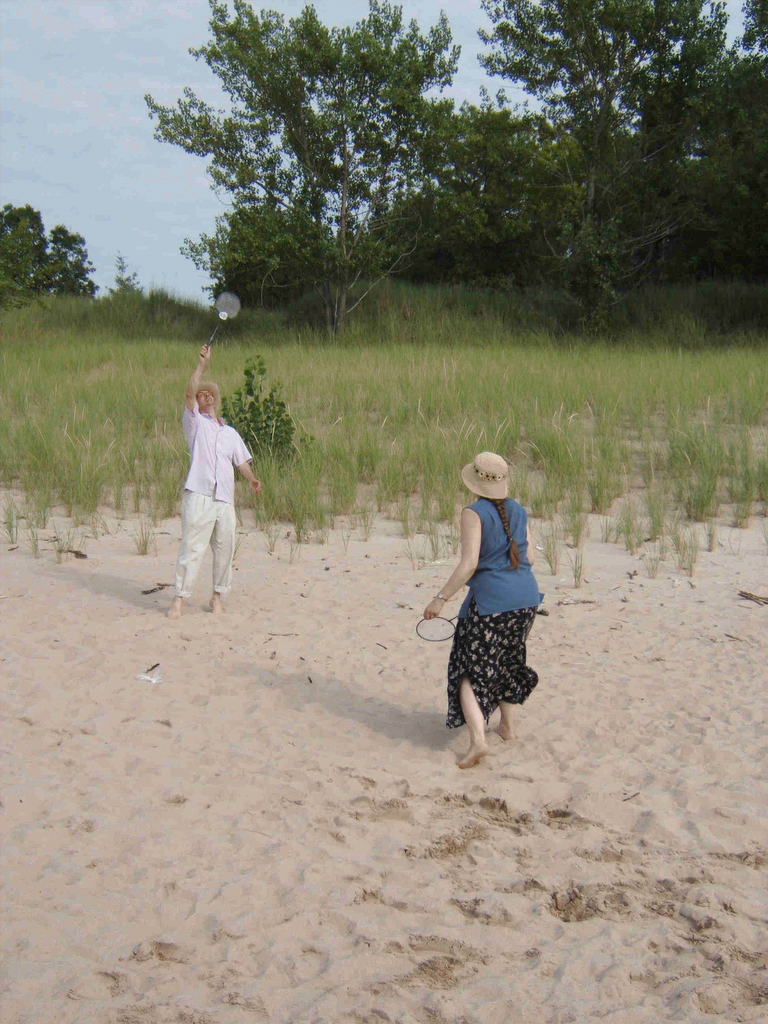
Badminton on the Beach

On The Beach
On the 19th of August, 1826, John Galt, novelist, poet, writer and business entrepreneur, along with his financial associates in London, England, were granted a charter for their corporation, The Canada Company, which eventually allowed them to purchase over a million acres in Upper Canada known as the Huron Tract, and they were granted this charter without any intimation that 180 years later my wife and I would be playing badminton on a white sandy beach along Lake Huron on the August Bank Holiday weekend.

They can be forgiven for this lack of foresight since badminton as we know it only truly developed in the 1860s, when British Army officers in India created a variation on the popular children's game Battledore and Shuttlecock by introducing a net and competition. The game was known as poona, from the city where the officers were stationed. However, in the year 1873, in the heart of sporting Gloucestershire, the Duke of Beaufort's country house saw many a military officer entertained, and one of their amusements was the playing of poona on the sumptuous grounds of the Duke's estate, Badminton House, and so the game was soon referred to as the "Badminton game," and then quite simply, badminton. Not far away in one of the oldest cities of Britain, the first badminton club was created, The Bath Badminton Club, 1877. Perhaps they inaugurated the opening with a taste of the medicinal waters which induced the Romans to settle there in A. D. 44 naming it Aquae Sulis after the Celtic goddess Sul.

As we casually played badminton on the beach, I thought of how the trajectories of the shuttlecock were similar to the trajectories that so entertained soldiers in India and on the Duke of Beaufort's estate, as well as the children playing battledore and shuttlecock on the streets of many an English village and city for hundreds of years. The trajectory of my own memories followed the shuttlecock, leading me back to recollections of holidays on Prince Edward Island playing badminton on Cavendish Beach as a youngster in the 1960s. The beach was not dissimilar; the scent of the dune grass and the rich marine essence in the air, the hot sun upon my arms, the warm sands beneath my feet, and the sound of the waves breaking upon the shore all helped to recreate a vivid recollection, and time seemed to have shifted forty years into the past. The trajectories of the shuttlecock revealed the rythyms of life in their novel patterns of flight, authors of parallel variations played out in our footprints in the sand.

Over The Horizon
I gazed and squinted, shaded by sunglasses, straw hat and the small colourful beach umbrella attached to the seemingly miniature beach chair in which I sat, my bare feet seeking out the cooler depths of the therapeutic sands. My wife beside me, likewise, reading, content. It was the distant horizon, however, that commanded my attention, the New York Times crossword having fallen to my lap, and the voices of our friends and family frolicking in the warm waters becoming part of the general chorus of holiday-makers carried on the breeze. The horizon is such a powerful symbolic line. An inspiration for the dynamics of change, of chance, of daydreams. I was that youth again, on that Prince Edward Island beach, staring out at the horizon, blue on blue, wondering where a straight line ahead would lead me. I had not learned that life rarely flows in a straight line, and I didn't know that many years later, I would be travelling the distant shores on the other side of that horizon, following the North Shore of the St. Lawrence River towards the Quebec/Labrador border where I would find myself having breakfast in the small Labrador town of L'anse au Loup on a foggy morning in the month of August.

It was the month of August in 1809 when the thirty year old John Galt found himself between landfall and departure at Gibraltar. Galt was on a business venture hoping to find ways to bring British trade goods to Europe via the Mediterranean to circumvent Napoleon's economic blockade. He was about to embark on a ship sailing to Sardinia, Malta and Greece and he had found refuge from the heat of Gibraltar by entering the library of the Military Garrison. As he sat reading, a younger man sat down beside him sighing heavily as if the weight of the world was upon him. Galt later wrote of him:

his dress indicated a Londoner of some fashion, partly by its neatness and simplicity with just so much of a peculiarity of style as seemed to show, that although he belonged to the order of metropolitan beaux, he was not altogether a common one.

He later caught sight of this uncommon young man aboard his ship bound for the wild Sardinian coast. It was, he learned, a young aristocrat named Lord Byron. Byron and his good friend John Cam Hobhouse, were travelling to the exotic Levant having been blocked on the overland route by the Napoleonic wars. Byron characteristically panned the overland Grand Tour route as nothing but "the common turnpike of coxcombs and virtuosos," justifying, no doubt, his forced trajectory via Portugal and Gibraltar. Little did John Galt realise as he gazed upon the horizon and hopeful promise of adventures gained, that he would publish a biography of Lord Byron twenty one years later based on his experiences sailing with the young poet.

I wonder though, did Byron forsee his own last horizon, when in September of 1809 he and Hobhouse sailed up from Greece to the then Albanian city of Preveasa passing the town of Missolonghi, remarking on its strange shoreline and the mountains rising into mystery beyond; a town where he was to die, helplessly and hopelessly, of fever in 1824 at the age of 36, the same year that Galt was busy writing to make money and busy with his plans for the Canada Company and the distant lands reaching the sandy shores of Lake Huron, where I sat with my wife enjoying the warmth of an August Bank Holiday, relaxing from our pleasurable exercise of badminton on the beach and ruminating on how life can be an enrichment of horizons with the promise of countless stories.