Showing posts with label Bookshop History. Show all posts

Tuesday, March 09, 2010

Brief Encounter: Ryszard Kapuscinski (or his Doppelganger)

There is nothing unusual about an author in a bookshop--a veritable cliché. As likely as a hand in a glove. Thinking about it now, I wonder if it was but a daydream.


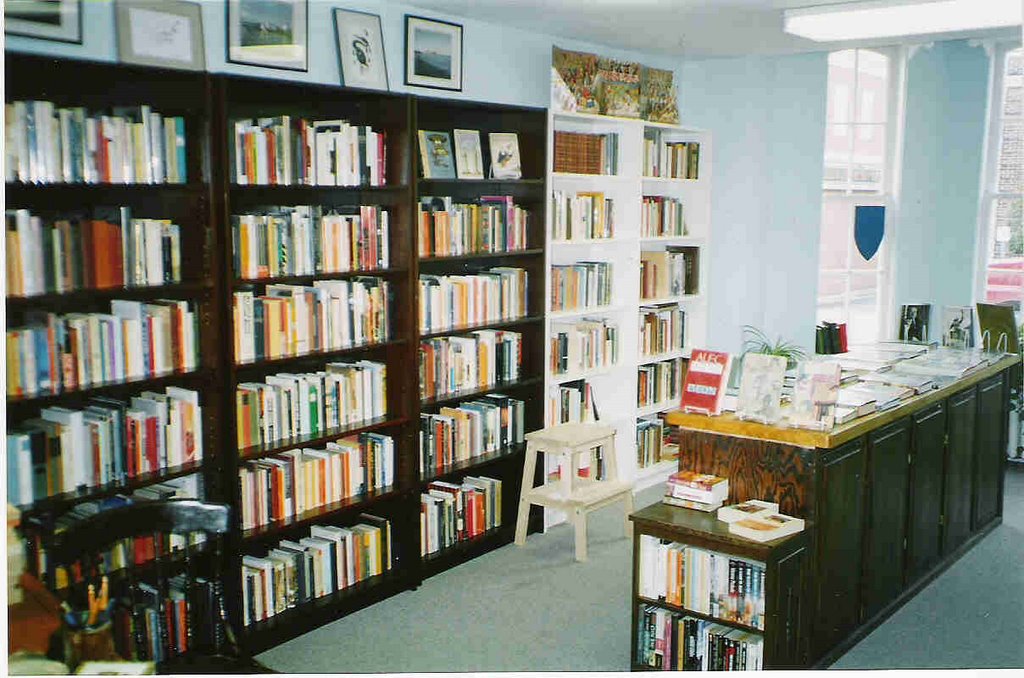
When operating a brick and mortar bookshop, I did have a variety of writers and illustrators visit on occasion. Some well known, some less so. It seems I had to open my own shop in a small Ontario city to have the experience of seeing an author browsing bookshelves in public. Having lived in Montreal most of my life, and a frequent visitor of most Montreal bookshops, French and English, I can't recall ever seeing a well-known author casually browsing. This lack of observational success would seem almost an example of carelessness. Then again, in my defense, my eyes were usually preoccupied with the lettering on book spines, my neck twisted to the side in a classic book browsing position. Also, it was long before book festivals like Blue Metropolis brought world renowned authors to the streets of that fair city.


So, there I was, sitting at my desk in the corner, when a professorial looking older man entered my very small bookshop. (I always greeted customers with eye contact and a hello. By dipping my toe into the waters of conversation I never knew where the small talk might lead. On many occasions it brought interesting discussions--people often sitting down in the chair in front of my desk, easing their physical and mental burdens and making themselves at home--while others lead but to the shallow depths of meteorological concerns. Some never made it past the greeting stage.) The man who had entered the shop reminded me of a neighbour on the street where I grew up, my best friend's father, an Edinburgh educated professor of Philosophy at McGill University specializing in Kierkegaard, now long retired and an Emeritus Professor. He quietly moved about the shop with a sense of shadowless energy. This was a man who was in no need of assistance. Someone who was at home amongst books. Looking intently at a bookcase only a few feet from me, he reached out and pulled a hardcover book from the shelf. He turned to me and said with a slight European accent, "This is a very good book, you know." The intensity of his eyes and the force of his confidence startled me. Slightly taken aback by the assertion, I agreed that it was indeed a very good book . (I now wonder why it had not moved for three years. Perhaps I had priced it too high. Perhaps I really wanted to keep the book for myself.) Having read the book many years ago, I felt less than confident in broaching the subject matter with the customer who looked so intellectually spry. Betting on my memory, I waited for a response, hoping he might elaborate and open up the possibilities for discourse. In a way it was rather like a game of chess. He had surprised me with an unusual opening move and I had responded with an awkward conventional response. He put the book back in place and looked about for a few more minutes, and then he turned and thanked me kindly with a nod, and made his way out the door. The game aborted, our respective pawns left at the border. I felt rather mystified.


I then went over and pulled the book out. Even though the man's physical appearance made me think it could possibly be the very author of the book, I was also thinking it couldn't have been; the likelihood of the author dropping by my little shop in a rural city in southern Ontario seemed so unlikely. I had read a number of his pieces in Granta Magazine over the years, and some of his works, but I was not familiar with his changing physical appearance. The book he had pulled off the shelf was Imperium by Ryszard Kapuscinski, the 1994 Canadian first edition, over ten years old at the time. The rear flap of the dustwrapper had what seemed to be an even earlier photograph of the author. I could see the resemblance. A younger version with those intense eyes. I walked quickly to the windows and looked out, but I did not see him. Out on the stoop, I looked up and down the street but he had quite vanished. I contemplated closing the shop and running out to find him, Imperium in hand like some madly obsessive Ryszard Kapuscinski collector.


But no, I remained where I was--trapped by new customers having entered the shop--wondering if indeed it had been the author. The remainder of the day was spent in creating imaginary conversations with him. I imagined us walking about the city streets, feeding the swans on the Avon, discussing great topics and great writers. Then I saw us repairing to a fine restaurant for a good meal and a pint of Guinness. Cigars and cognac were probably conceived, the author regaling me with stories from his travels and extraordinary experiences. Such was the imagination of a bookseller who spent his days behind a desk surrounded by books and dust, daylight framed by a shop window.


I remember carrying the book in my book bag as I traversed the city over the next few days in case I happened across the him sitting in an outdoor café or buying toothpaste at a drugstore, but I was not fortunate in this serendipitous concern. I did not, however, stop people on the sidewalk asking if they had seen Ryszard Kapuscinski by any chance. Trying to sell books was crazy enough.


This unusual brief encounter with the author, or his doppelganger, I took as a form of admonishment and put the book back in my personal collection for future reference and re-reading. One day, perhaps, he would be in Toronto for a literary festival and I could try to approach him for a signature and ask him if had ever visited my small shop in a small southern Ontario city and, coming across this very volume, had asserted how very good it was. The meeting, however, was not to be. Ryszard Kapuscinksi died in January of 2007.


It it wasn't the author who visited my shop, then his doppelganger makes it doubly interesting. I think I would rather have the question to this one, than the answer.

Friday, March 30, 2007

Author, Author: a Bookstore Story

One day at our small second-hand bookshop, a quiet day per usual, the phone rang, unusual in itself, and it was one of my bookclub members, an owner of one of the independent retail bookshops in town. A customer of his was looking for a certain title which seemed to be out of print. It was a pleasant feeling to know that I did in fact have a copy, a very nice trade paper reprint. He said that was wonderful, he would send his customer over. 

Just before my anticipation began to wane and just before my mind returned to its maunderings, a woman quietly slipped into the shop. The effect of her silent arrival, startling me just at the point of my falling into dreamy bookish preoccupations, must have shown on my expression, and in my voice as I greeted her in a rather hesitant and stilted fashion, the blood rushing to my face. For the woman who had entered was a rather famous Canadian author. Should I rise from my desk and become exceedingly gracious? No, that would just scare her. Somehow I managed to remain calm, but I think it was shock. She approached the desk and very kindly inquired about the book being held for her. I duly handed it to her and she said it was excellent, she would buy it, but she would browse the shelves for a bit as well. 

At this point, I hadn't broached the subject of her identity, not knowing quite how to do so. I didn't possess the charm of my brother-in-law, an actor, and on top of it all, I was having a bad hair day and I was feeling much like Dylan Moran's Bernard Black. Well, she started to look at the fiction and I saw her work her way down to where her books would be. My eyes followed her hand which reached out to gently pull a volume off the shelf before saying "I see you have one of my books."

Now, at this point I may have been seen as daft for not knowing a famous Canadian author, so I tried to salvage my self-respect by saying how nice it was to have Alice Munro in our little bookshop, and would she like to sign the book for me. She brightened up at this request and sat down on the chair in front of my desk and I handed her my pen and she very kindly signed her name on the title page. I asked her if she was in town for the theatre, but she said she dropped into town from time to time. Then she told me that she used to run a small bookshop. I was quite ignorant of this fact. Yes, she and her first husband started a little bookshop in Victoria, B. C. and it specialized in paperbacks. This was the early 1960s. She said she did all the jobs from running it to cleaning it too. Of course, it dawned on me, Munro's Books in Victoria. It has evolved. And so has she. I can't remember the rest of the conversation, but I do recall how pleasant and kind she was. A very nice person. 

On another occasion, my wife was at the shop when Alice Munro was looking for an older classic, but together they couldn't find a copy. When I arrived she had just left. I said I could have sworn we had a copy of that title. I scanned the shelf, then the shelves around and yes there it was, hidden behind other books on the wrong shelf altogether. My wife, a librarian, is the Queen of finding mis-shelved books but somehow this one had eluded her keen eye.

I ran to the window. No one to be seen. To the door but no, she had vanished. I descended the stairs and looked up and down the street and I saw her walking at a jaunty stride with her husband, and off I went clutching the inexpensive paperback in my hand like it was forgotten medicine. Shuffling before the sprint I realised I would actually have to run and not jog. 

I discovered not only was I out of shape, but how difficult it was,  for an untrained voice facing a head wind, to call out to someone far ahead. But somehow I managed to reach them at the corner and she thanked me for the effort. My ability to respond adequately was of course countered by the fact that I could hardly breathe, but somehow this too I managed. And off they went, and off I went with the price of the paperback in my hand.

As I walked back to the shop, I did try to regain some poise.

Only later, in the calm of the empty shop, did it occur to me, that a strange young man running after them waving a paperback in the air must have been a startling sight, certainly to her husband who'd never laid eyes on me before.  Some raving fan with a book for her to sign? A talker perhaps? A follower even. Someone to avoid. Excuses forming. Late for a play, must dash . . . .

Such was the day's excitement.


Monday, November 06, 2006

Forty Eight

This afternoon I locked the door to Chumley and Pepys Secondhand Books at 48 Albert Street, Stratford, for the last time. I put two garbage bags out and handed the keys in to the owners of the building. It was a good feeling. We were ready to move on.

After two months of wretched weather, it was a glorious day. We finally had a taste of Indian summer with the sun shining benignly and the temperature reaching 14 degrees. Cats were enjoying the warmth and squirrels were nervously busy but with a lighter bounce to their hops. The river Avon's water level had been lowered for the winter and the flocks of Canada Geese looked rather perplexed. Yes, it was a good day for closure.

Last Friday, stressed and exhausted, my wife and I were busy with last minute packing of odds and ends. We were removing the contents of an old wooden filing cabinet I had brought with us from Montreal, business files, christmas decorations, old audio cassettes, and junk, when upon opening the second drawer we looked down to see two large wooden numbers, a 4 and an 8, which I had bought long ago and painted the store colours, blue and gold, but had never used on the exterior signage. Last Friday was my 48th birthday. We both smiled at each other and remarked on the coincidence of closing the 48 Albert Street Bookshop on my 48th birthday. We had been so busy, we never thought about it until those wooden numbers played their part. It was a deftly cut jig saw piece that fit right in place.

Thursday, November 02, 2006

c'est le paysage longtemps...


Dust motes and bare shelves, tired thoughts and diminshed energies; hard to think I shall close the door and never return. Today, after almost a week of packing and moving boxes of books, my resolve and my ability to rise to the required challenge were at their lowest ebb. It was at the close of day, the light fading into a steel november dusk, that I came across an old audio cassette which had fallen behind a cabinet. An audio cassette I had taped of an interview with Joseph Campbell in 1981. On the other side I had taped the countertenor Alfred Deller singing John Dowland's songs with Robert Spencer, lute, and the Consort of Six. Holding this old "Intermagnetics" 60 minute audio cassette, was like finding a lost thread of light directing me out of the of the bibliographic labyrinth I had entered three years ago. I sat on the weathered oriental carpet and my thoughts travelled back to conversations on philosophy, literature, art and music with a friend in the cafes of Montreal on la rue St. Denis and boulevard St. Laurent. The friend who lent me his old slightly scratchy album of Alfred Deller singing Dowland, and the one who told me of Joseph Campbells work. The days of haunting secondhand bookshops for Kierkegaard, Donne, Conrad or Durrell; and record shops in search of those Angel Records of Freni, Baker, or Schwarzkopf, or Blue Note Records of Miles Davis and other giants, or those ECM albums which were so in vogue...

At home, I showed my wife the cassette and we listened to it together. It was a pleasure to be able to share a part of my life of 25 years ago, but saddening, for the world seems to be running further away from the philosophical truths Campbell believed in.

At the beginning of the day, however, I turned on CBC radio as I usually do when I enter the shop, and the classical request show Here's to You with Shelley Solmes . She was introducing a piece of music requested by someone who said he had had a dream of listening to this piece of music with a friend, and so would like to hear it on the show. It was the villanesca by Granados from his Danzas Espanolas. Angela Hewitt on the piano. That alone was interesting. A dream of listening to a specific piece of music. With someone. Unusual. But what had me transfigured into a statue of apprehension was that the piece of music was important to me as well. In fact, last night I had rumaged through some old video-cassettes and discovered a film I had taped off the television, one of my favorite French films of the 80s, Peril en la Demeure(1985) with Richard Bohringer one of my favorite actors who also appears in Diva, another favorite film of the 80s. This piece of music by Granados traces a thematic thread through the film. I watched the movie and was reliving that late 1980s and early 1990s period of my life.

Coming to the end of one pursuit I seem to have been shown the past, as if the recent three year section of my life had just shifted into puzzle position, interlocked with past events to reveal a larger picture. A final piece for the middle panel of the triptych of my life. This makes me think of Bohringer again, playing an interesting character in the film Diva, working on a very large puzzle, listening to ambient music and finding that last piece.

C'est le paysage longtemps, c'est une cloche,
c'est du soir la delivrance si pure-;
mais tout cela en nous prepare l'approche
d'une nouvelle, d'une tendre figure...
Ainsi nous vivons dans un embarras tres etrange
entre l'arc lointain et la trop penetrante fleche:
entre le monde trop vague pour saisir l'ange
et Celle qui, par trop de presence, l'empeche.
-R. M. Rilke

Sunday, October 29, 2006

Chumley's, New York, Pamela Courtyard Revisited


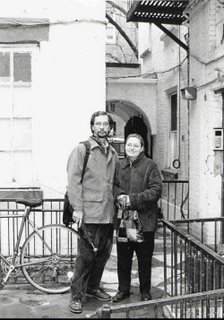
While making a card for my brother-in-law's birthday, I came across one of our scanned photographs which I had forgotten about. My wife and I are standing in Pamela Courtyard behind Chumley's looking towards the back entrance (and Brian my brother-in-law who is taking the photograph.) The brick archway rises behind us on Barrow Street. I kept looking at all the windows facing down on this courtyard, wondering who lived in these convenient dwellings, and what their stories were. Thinking too of all the writers, muscians and artists who have used this passageway on their way in, or out, of Chumley's.

Having just watched the Audrey Hepburn, Fred Astaire movie Funny Face, I can imagine Fred doing a neat dance number in the confines of Pamela Courtyard, using the wrought iron and the walls to create an acrobatic dance display. Is there an umbrella in it? Yes, I think so. In the movie Funny Face, there is a great dance number of Audrey Hepburn in a Parisian "beatnik" cafe, which reminded my wife of Mike Myers' funny routine of the sprockets on Saturday Night Live. Black turtle necks and all. Funny stuff. (Come to think of it, it also reminds me of his film So I Married an Axe Murderer, where he plays a poet who recites his works to jazz in a beatnik-like San Francisco cafe. More funny stuff. )

What has this to do with books? Well, Audrey Hepburn plays a clerk in a secondhand bookstore in New York, and the scenes in the bookshop are interesting for anyone who would like to slide down a room on a library ladder. We all need to dream.

Tuesday, October 24, 2006

A Macclesfield Mayor, a mysterious painting, and my love of books and art.


Recovering the past is to walk the labyrinth of inner thoughts. One hopes to find sources of meaning on the way in, and one hopes to discover sources of strength on the way out. My devotion to books has brought me great pleasures and much delight, but it is a devotion which comes with a literal weight. As I contemplate moving a bookshop, a small one though it is, I find myself overwhelmed with the thought of it. When I close my eyes I may be avoiding the task at hand, but I am really treading the maze-like path towards a recollection of the past in my search for the source of my love of books. And hopefully a source of strength on the way back.

The initial influence would be my Great Uncle, who inscribed his book gifts to us as "Uncle Ivan." He was my Mother's uncle who lived in the city of his birth, Macclesfield, England. My grandfather, Francis Herbert, was the only sibling of five brothers to emigrate. He, like his brother Ivan, was a talented amateur painter, and this was one of their common interests. The other, I believe, was to surround themselves with a few nice books. Some of my grandfather's books have passed down to me. Nothing truly old, rare or valuable, but valuable to me for their association and for his name inscribed on the occasional endpaper. These books would be the second influence. They used to reside on the top-most shelves of my parents bookcase, out of reach, thankfully, of a child's crayon world, abiding their time, silently awaiting the day when they could reveal their hidden magic. I remember standing on a chair, breathing in the heady odours released as I fanned their pages. I sometimes think that this is what hooked me on books. Their aesthetic, tactile and odiferous qualities. Ideas came later. Breathing an old book's scent can bring me back in time much like Proust's madeleine or the uneven paving stone. It can be ambrosial in nature. A relaxant for the mind. The third influence would be from an older cousin on my father's side of the family who gave us wonderful books for christmas presents. A set of four Joseph Conrad novels set me off on a life-long enjoyment of his works.

These influences reinforced each other to guide me along as a nacent book-fancier. Never having the money to buy from catalogues and such, I turned into a bookscout for my own desires. Church sales, garage sales, public library sales, and academic institute and university library sales were common sources. Invariably it meant lining up for long periods of time, often in inclement weather as most sales took place in the fall and the spring. These entailed competition and sweaty scrums. More enjoyable by far was browsing calmly in secondhand bookshops, each with their own charm, quality and selection. Some have long gone, buildings swept away for large plazas and downtown hotels, while others continue to thrive. I think how pleasant it would be to revisit my favorite Montreal bookshops. All booklovers have their stories and memories of bookshops and proprietors. Maybe some will even remember old Chumley & Pepys.

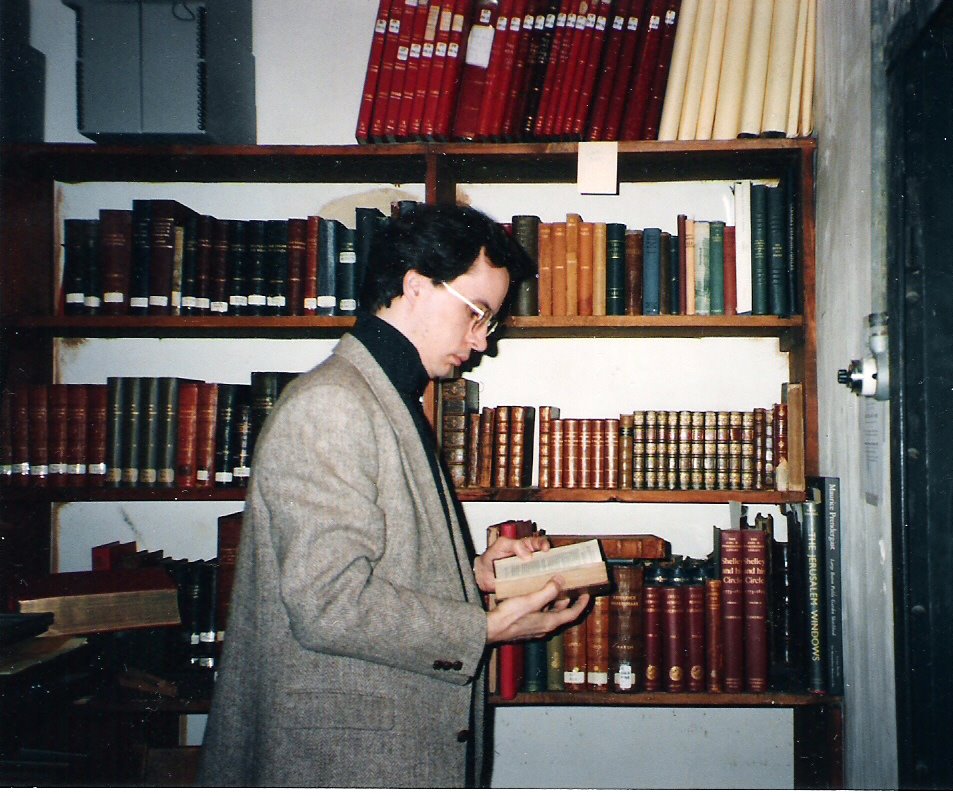
Books have led me on to work in a library and to pursue a library degree, which led me to the challenge of working on the archives of an old institute, and to the pleasure of cataloguing old books. The photo above captures me in my element, looking a bit younger and fresher, in the institute archives in 1992, perusing a volume of Montaigne's Essays. Probably his essai "On Books." I can see why Paul Theroux would like to carry a penguin paperback of Montaigne's Essays with him on his travels. It would be a good general companion.

These are my fancies, in which I make no attempt to convey information about things, only about myself. -Montaigne

What of the "Mayor" and the "mysterious painting?" Well, as I have said elsewhere, life rarely flows in a straight line, and so here too, in my meditation on my love of books, I recalled a story of my uncle Ivan. In his later years, before I was born, he finally paid a visit to Canada to see his brother Francis. Ivan was at the time the Mayor of Macclesfield, and so he brought one of his own paintings to present to the Mayor of Montreal, Camillien Houde. Houde had a checkered career but during the the 1939 Royal Visit, he seemed to have charmed the Queen and Prince Philip. At an official dinner, he sat beside the Royals and was reading a list. When asked what he was reading, he told Prince Philip that it was a list of subjects he was not to bring up and discuss with them. He passed the list to the Prince who responded with robust laughter. Nothing like honesty to break the ice. Supposedly the Queen thought him the most interesting of Mayors and said so when back in England. Perhaps this is what prompted my great uncle's gift. Good publicity. The fact is I have always wondered what became of this painting. Does it still reside somewhere in Montreal's City Hall? Was it stored away and later sold? Or did it stay with the Mayor's family? Perhaps there is a descendent of Mayor Houde who inherited this painting, and she or he is standing in front of it as this moment, whatever moment that is, wondering who the painter was and how it came to be in the family. This unresolved story is like one of the those distant pathways leading off into a misty valley. A pathway I have been meaning to follow. Perhaps when I revisit my favorite bookshops in Montreal, I could try to solve this question, and by solving it, discover another story to tell.

And what of the possible sources of strength to help me face the task at hand? Well, having traced my love of books to relatives, I must pause and think of their stories. A classic story of immigration, struggle and success; sons and brothers fighting in the second world war, persistence and hard work . . . . Moving a little bookshop is really nothing in comparison. So when I find myself bemoaning my sore back, I shall just think of my forebears and all they have strived for over the last century. That should give me perspective. And strength for that last box of books.


Monday, September 25, 2006

Chumley's New York Redux


During the first year of operating Chumley & Pepys Second-hand Books, a customer came in and asked if we had any connection to Chumley's in New York City. Nope. No connection. But six months later there we were.

My brother-in-law was in the production of King Lear starring Christopher Plummer that year in Stratford, and Christopher Plummer took it to the Lincoln Center over the winter. It was our opportunity to make the circle complete.

We travelled overland using our VIA points to the border, and enjoyed a train car with the ideal temperature and hot Red Rose Tea--"only in Canada, you say. Pity." Then it was tepid Lipton's Tea--don't they make soup?--and overheated train cars from Niagara Falls to New York City. Oh, well, it was cheaper than flying. We only had three full days in New York so we had to narrow the tourist possibilities to our specific interests: libraries, books, art, tea and Chumley's. Beside the performance of King Lear of which Christopher Plummer had me in tears again, we managed to squeeze The Brooklyn Bridge, Central Park, Time's Square, and a quick tour of Soho and the Village into our itinerary. New York is inexhaustible. Three days was just a taste, but enough to see the Cloisters, The Frick Museum, New York Public Library, Colliseum Books, Gotham Book Mart, The Strand Bookshop, as well as enjoying much needed sustenance at Alice's Tea Cup, Zen Palate and a great little Italian Bistro on Columbus.
Greenwich Village alone could easily take three days of exploration. So many writers and their fictional characters have lived in this literary and artistic neighbourhood: Thomas Wolfe, Djuna Barnes, e. e. cummings, Sherwood Anderson, Marianne Moore. The list could on and on. We passed 75 1/2 Bedford which is a very narrow red bricked building where Edna St. Vincent Millay lived for a short time. And it was along this stretch of sidewalk that Saul Bellow's Charlie Citrine walked on his way to visit Humboldt who lived on Bedford Street near Chumley's. Simone de Beauvoir found it to be a place conducive to writing, reading and good conversation. She said it had "atmosphere." I can't remember where I heard that F. Scott Fitzgerald and Zelda had their wedding reception at Chumley's. Probably from the same source who told me that the newlyweds had conceived their first child there. Sounds like hearsay. But then again. . . .
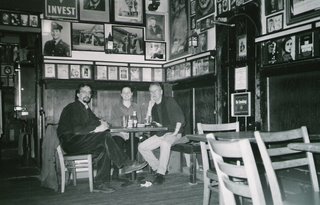
Chumley's, 86 Bedford: we arrived at 1 p.m. not knowing that it didn't open till later in the afternoon. This wasn't a problem for they didn't have signage let alone hours of operation posted. We just tried the door. It opened. We heard, oddly enough, British accented voices rising from the depth of the pub. We entered as if into another dimension, feeling like we just stepped out of the Tardis and were following Dr. Who into another adventure. We found ourselves amidst a large group of 17 year olds and a few middle-aged overseers. It turned out it was an F. Scott Fitzgerald literary tour for a public school from England and Chumley's had opened especially for them. We were just lucky. We sat down at a table and picked up what we thought was a menu but it was really a plastic folder providing the students with literary information on Fitzgerald et al. They did allow us to stay for my brother-in-law's British accent and natural charm paved the way with the British teachers and the pub manager. After all, it was a pilgrimage like theirs, and special for it was a Chumley in search of a Chumley. Well, figuratively. The portobello burger, fries and a beer set us right. We took photographs and browsed before leaving by what was originally the front entrance on Barrow Street and its fascinating courtyard, feeling the gods were looking kindly on us that day. We were entranced by Pamela Courtyard and the brick archway on 58 Barrow Street. In prohibition days, the owner, Leland Chumley would stall the police here while the patrons left by the exit at 86 Bedford. The euphemism "86 it" was in common parlance for many years as the code for "let's get out of here".
Street front anonymity hasn't hindered this unique meeting place. It's introverted character conceals a creative and imaginative extroverted joie de vivre. Most especially on a Friday night I imagine.

Thursday, August 10, 2006

Another day

Another day, another dollar. Literally. Such a day clears away illusions like a broom to cobwebs.

The ups and downs of business should help burnish the resilience of character. At least one hopes. However, I have known some old second-hand booksellers whose resilience of character may have been burnished to excess. Perhaps to the point of eccentricity. Such ups and downs are a challenge, but ones that should develop character. Or is it eccentric characters that they develop?

In leaving the stage of a bricks and mortar bookshop and shifting to the virtual privacy of selling books on-line, we may reduce the patina which seems to develop when exposed to many years of the second-hand book trade, but we will miss the people. That is the greatest enjoyment. Meeting interesting people and learning their stories in casual conversations. Though we will miss the direct human contact, the on-line relationships will be another facet to experience and we look forward to that challenge.
And so life goes on.

Tuesday, August 08, 2006

from O.O.P.s to P.I.P.s

A retired couple visited our book shop in Stratford, Ontario, on August 8th, and the husband enquired as to whether I had any Leonard Cohen books, or were they out of print. I assured him that Leonard Cohen's books were very much in print. In fact, I told him I had noticed a reprint trade paper edition of his first book, Let Us Compare Mythologies, in a window display of Fanfare Bookstore, one of the fine independent Stratford booksellers. (For the collector out there, the original publication, a McGill University Poetry Series Chapbook, is now worth a great deal in dollar terms. Though that is insignificant when compared with its poetic value.) I showed him my one remaining Leonard Cohen book, a selection of his poetry published by McClelland and Stewart . He had it already.
I have a hard time keeping Leonard Cohen books on the shelf. That is a good thing. A poet with perennial interest and appeal for both old and young is quite something. But Leonard Cohen is quite something. I wish I could avail myself of the phone and order a mixed box of Leonard Cohen's works but that is retail. I am in the second-hand trade. For me it is hunt and gather and hope for the best. A few weeks ago, a younger couple was in browsing. I recognized them as I do all my annual customers, with a touch of uncertainty. (Aging memory files take a bit longer to process when your customers only visit once a year. Such is the tourist town.) They had noticed a few works by Cohen a year ago but had not bought them. Of course they had been sold. That's the second-hand book trade, buy it when you see it. And today I put my last Leonard Cohen book in the window beside the selected correspondence of Jack McClelland, and yes, a woman came in and bought it like she had been expecting it to be there all the time. And tonight as I did a search for
Leonard Cohen on the Internet, I discover he is in Berlin for special concert events August 11-13, 2006.
August 8th is the eighth day of the eighth month, and the number 8 is one of the important numbers in Buddhism, and Leonard Cohen is well known for his interest in that spiritual path. Hey, it makes you think.
My first customer should never fear that Cohen's books will be out of print. And with sites such as
Project Gutenberg, which provide full-text on-line edtions for free viewing, there is a future cushion of internet immortality. Out of print books, what I call O.O.P.s, will become Perpetual In Prints, or P.I.P.s
And so life goes on.

Thursday, August 03, 2006

Desires and Fulfilments

My wife and I have been running a bricks and mortar bookshop in beautiful Stratford, Ontario, Canada, for three years now. We named it Chumley & Pepys Second-hand Books after two cats. The cats were imaginary. They still are.
At the time we had a large handsome muscular orange tabby whose name was Cinnabar, an affectionate feline with a touch of human nature, and we didn't want to usurp his position with two upstart crows. (He never did know the shop was named after fictional replacements. He would have been indignant -- for a while anyway.) Cinnabar did, however, embody the characteristics of the imaginary cats, for there was a healthy portion of "Chumley" in him, and a touch of "Pepys" as well. Although Cinnabar has passed on, and his ashes reside in an urn nestled amongst books and plants with a window view, his replacements remain very much in the imaginary world. And so life goes on.

Both trained in librarianship and steeped in language, literature and books, we chose the names not only for their visual and sonorous qualities, but also for their literary references.
Chumley would seem less obvious, more obscure in its literary antecedents. Originally, and perhaps formally, it is spelled Cholmondeley. It is a name of a great English family who have been hereditary King's Chamberlain for over 200 years. The family seat in Cheshire,
Cholmondeley House, is well known for its gardens.
The authors who we had in mind are
Mary Cholmondeley and Alice Cholmondeley. Mary was a 19th Century writer who is best known today for her novel Red Pottage. Alice Cholmondeley was the pseudonym used by Elizabeth von Arnim for one novel, Christine. She wrote many novels under her own name and is best remembered for her book Elizabeth and her German Garden, and her novel Enchanted April, which was turned into an enchanting film.
The pronunciation of Cholmondeley as Chumley seems at first mystifying, but upon looking at word origins, one can see how pronunciations were changed over time, anglicized from their French or Anglo-Saxon origins. Interestingly enough, Elizabeth von Arnim's maiden name was Mary Anne Beauchamp, pronounced Beecham. It appears some families adapted the spelling to the pronunciation for simplification, and so one finds both Cholmondeleys and Chumleys, or Beauchamps and Beechams. The name Featherstonehaugh, pronounced Fanshawe, is but another example. A "haugh" is derived from Middle English, and refers to a flat piece of alluvial land near a river. How "featherstone" became "fans" would require more investigation. I leave that to your curiosity.
As for Pepys, pronounced Peeps, we of course refer to
Samuel Pepys (1633-1703), diarist, bookcollector, bon vivant, Secretary of the Admiralty, and President of the Royal Society. Not bad for a tailor's son. Pepys benefited from the patronage of his father's first cousin Edward Montagu (later to become the first Earl of Sandwich), and worked his way up from a lowly clerk with diligence and strength of character. This is revealed in his famous diary which he kept from January 1, 1660 to May 31, 1669. It is remarkable both for the insight into his own character and for the record of contemporary events and his involvement in them.
He was also a bibliophile. His personal library of 3,000 volumes was arranged by size, from No. 1 the smallest, to No. 3,000 the largest. It includes medieval manuscripts, incunabula, books relating to the navy, and his own diary in six volumes written in Shelton's shorthand. After the death of his nephew, John Jackson, the library, complete with bookpresses and library desk, was given to Pepys's alma mater,
Magdalene College, Cambridge where it now resides in a special room.
So, from that early desire many years ago, to have two cats named Chumley & Pepys one day, we did achieve their imaginary representation in the bookshop name and logo. We plan to shift our bookselling business on-line. Perhaps once we leave our bricks and mortar shop behind, we can bring the imaginary cats into present reality. A transposition and a fulfilment of desire. And so life goes on.