I am invariably impressed by the prolific John Galt for he was not just a writer of many novels, plays, biographies, travel, and occasional verse, but he was a business man to boot. It brings to mind the prolific career of Alexander McCall Smith, an accomplished academic in medical law and ethics with many academic texts and papers to his name, and the author of a great many truly wonderful works of fiction. I am humbled by his output, which quite outstrips Galt's in quantity and quality. And I don't think Galt ever picked up a sousaphone or a countrabassoon either. Anyway, I couldn't resist posting this poem by John Galt because he uses the word, chumley in such a cheery context. I am not sure if Spring has arrived in Scotland as yet this year, having heard of heavy snow only recently, but it is certainly spring in Southern Ontario. I even hear that Thunder Bay has finally experienced this rare season.
This poem would do well to be read aloud. There are many good Scottish actors whose voices would be fine for this poem, David Tennant, Robert Carlyle, or Ewan McGregor perhaps, but I think the older actor, Bill Paterson would be ideal. I try to hear his voice as I read this poem to Spring. Come to think of it, he would be the perfect actor to portray John Galt himself.
Spring
suggested by the fourth ode of the first book of Horace
Wha's yon braw lass, wi' gowan snood,
That's walking o''er the broomy knowe;
She dings the cranreuch fae the wood,
And plaits a garland round the bough?
Her e'en, twa dew-drops, sparkling clear,
Shed love and daffin' as they glance;
The birds wi' canty liltings cheer,
And a' the flow'rs rise frae their trance?
It's bride-maid Spring, whose leilsome art
Gars lightly loup the youthful heart.
II
Thrang frae the misty highland isles,
Whar ghaists in flocks glowr as they flee,
And Brownie for the Lathron toils,
Wi' barkened sails the kowters see--
By heaps o' timber caps, and plates,
The wark that wile't the winter's drear,
Right snod the kintra carlin waits,
And wearies wha the price will speer.
For a' the lads are on the rig,
And she maun thole the snash and prig.
III
The clachan lucky spreads fu' proud
Her webs and spyniels on the green;
And signs and window cheeks renew'd,
Like the young leaves shine fresh and clean.
But lo! best proof that winter's done,
Auld grannie frae the chumley nook
Late toddling in the afternoon
To kirk, wi' napkin round her book.
In love, or life, or growth, or sense,
All feel the genial influence.
IV
Come then, dear Jamie, while we may
The vernal hours of youth enjoy:
The hope that blooms so fair and gay,
A worm may gnaw, a blast destroy.
But o'er the past, as Horace sings,
Not e'en almignty Jove has power,
And mem'ry still delighted brings
The vision of the happy hour;
That man in joyless age may bear
The wumbling pain, and snuling care.
-Poems by John Galt (London: Cochrane & M'Crone, 1833) p. 41-42.
I am invariably impressed by the prolific John Galt for he was not just a writer of many novels, plays, biographies, travel, and occasional verse, but he was a business man to boot. It brings to mind the prolific career of Alexander McCall Smith, an accomplished academic in medical law and ethics with many academic texts and papers to his name, and the author of a great many truly wonderful works of fiction. I am humbled by his output, which quite outstrips Galt's in quantity and quality. And I don't think Galt ever picked up a sousaphone or a countrabassoon either. Anyway, I couldn't resist posting this poem by John Galt because he uses the word, chumley in such a cheery context. I am not sure if Spring has arrived in Scotland as yet this year, having heard of heavy snow only recently, but it is certainly spring in Southern Ontario. I even hear that Thunder Bay has finally experienced this rare season.
This poem would do well to be read aloud. There are many good Scottish actors whose voices would be fine for this poem, David Tennant, Robert Carlyle, or Ewan McGregor perhaps, but I think the older actor, Bill Paterson would be ideal. I try to hear his voice as I read this poem to Spring. Come to think of it, he would be the perfect actor to portray John Galt himself.
Spring
suggested by the fourth ode of the first book of Horace
Wha's yon braw lass, wi' gowan snood,
That's walking o''er the broomy knowe;
She dings the cranreuch fae the wood,
And plaits a garland round the bough?
Her e'en, twa dew-drops, sparkling clear,
Shed love and daffin' as they glance;
The birds wi' canty liltings cheer,
And a' the flow'rs rise frae their trance?
It's bride-maid Spring, whose leilsome art
Gars lightly loup the youthful heart.
II
Thrang frae the misty highland isles,
Whar ghaists in flocks glowr as they flee,
And Brownie for the Lathron toils,
Wi' barkened sails the kowters see--
By heaps o' timber caps, and plates,
The wark that wile't the winter's drear,
Right snod the kintra carlin waits,
And wearies wha the price will speer.
For a' the lads are on the rig,
And she maun thole the snash and prig.
III
The clachan lucky spreads fu' proud
Her webs and spyniels on the green;
And signs and window cheeks renew'd,
Like the young leaves shine fresh and clean.
But lo! best proof that winter's done,
Auld grannie frae the chumley nook
Late toddling in the afternoon
To kirk, wi' napkin round her book.
In love, or life, or growth, or sense,
All feel the genial influence.
IV
Come then, dear Jamie, while we may
The vernal hours of youth enjoy:
The hope that blooms so fair and gay,
A worm may gnaw, a blast destroy.
But o'er the past, as Horace sings,
Not e'en almignty Jove has power,
And mem'ry still delighted brings
The vision of the happy hour;
That man in joyless age may bear
The wumbling pain, and snuling care.
-Poems by John Galt (London: Cochrane & M'Crone, 1833) p. 41-42.
 On The Beach
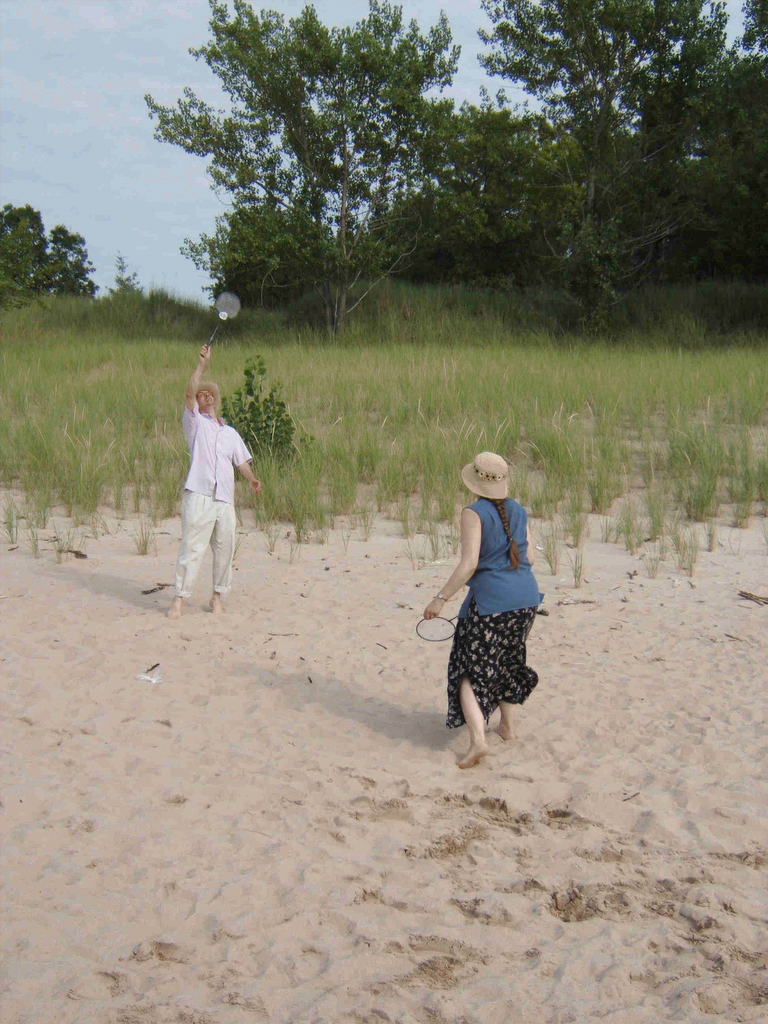
On the 19th of August, 1826, John Galt, novelist, poet, writer and business entrepreneur, along with his financial associates in London, England, were granted a charter for their corporation, The Canada Company, which eventually allowed them to purchase over a million acres in Upper Canada known as the Huron Tract, and they were granted this charter without any intimation that 180 years later my wife and I would be playing badminton on a white sandy beach along Lake Huron on the August Bank Holiday weekend.
They can be forgiven for this lack of foresight since badminton as we know it only truly developed in the 1860s, when British Army officers in India created a variation on the popular children's game Battledore and Shuttlecock by introducing a net and competition. The game was known as poona, from the city where the officers were stationed. However, in the year 1873, in the heart of sporting Gloucestershire, the Duke of Beaufort's country house saw many a military officer entertained, and one of their amusements was the playing of poona on the sumptuous grounds of the Duke's estate, Badminton House, and so the game was soon referred to as the "Badminton game," and then quite simply, badminton. Not far away in one of the oldest cities of Britain, the first badminton club was created, The Bath Badminton Club, 1877. Perhaps they inaugurated the opening with a taste of the medicinal waters which induced the Romans to settle there in A. D. 44 naming it Aquae Sulis after the Celtic goddess Sul.
As we casually played badminton on the beach, I thought of how the trajectories of the shuttlecock were similar to the trajectories that so entertained soldiers in India and on the Duke of Beaufort's estate, as well as the children playing battledore and shuttlecock on the streets of many an English village and city for hundreds of years. The trajectory of my own memories followed the shuttlecock, leading me back to recollections of holidays on Prince Edward Island playing badminton on Cavendish Beach as a youngster in the 1960s. The beach was not dissimilar; the scent of the dune grass and the rich marine essence in the air, the hot sun upon my arms, the warm sands beneath my feet, and the sound of the waves breaking upon the shore all helped to recreate a vivid recollection, and time seemed to have shifted forty years into the past. The trajectories of the shuttlecock revealed the rythyms of life in their novel patterns of flight, authors of parallel variations played out in our footprints in the sand.
Over The Horizon
I gazed and squinted, shaded by sunglasses, straw hat and the small colourful beach umbrella attached to the seemingly miniature beach chair in which I sat, my bare feet seeking out the cooler depths of the therapeutic sands. My wife beside me, likewise, reading, content. It was the distant horizon, however, that commanded my attention, the New York Times crossword having fallen to my lap, and the voices of our friends and family frolicking in the warm waters becoming part of the general chorus of holiday-makers carried on the breeze. The horizon is such a powerful symbolic line. An inspiration for the dynamics of change, of chance, of daydreams. I was that youth again, on that Prince Edward Island beach, staring out at the horizon, blue on blue, wondering where a straight line ahead would lead me. I had not learned that life rarely flows in a straight line, and I didn't know that many years later, I would be travelling the distant shores on the other side of that horizon, following the North Shore of the St. Lawrence River towards the Quebec/Labrador border where I would find myself having breakfast in the small Labrador town of L'anse au Loup on a foggy morning in the month of August.
It was the month of August in 1809 when the thirty year old John Galt found himself between landfall and departure at Gibraltar. Galt was on a business venture hoping to find ways to bring British trade goods to Europe via the Mediterranean to circumvent Napoleon's economic blockade. He was about to embark on a ship sailing to Sardinia, Malta and Greece and he had found refuge from the heat of Gibraltar by entering the library of the Military Garrison. As he sat reading, a younger man sat down beside him sighing heavily as if the weight of the world was upon him. Galt later wrote of him:
his dress indicated a Londoner of some fashion, partly by its neatness and simplicity with just so much of a peculiarity of style as seemed to show, that although he belonged to the order of metropolitan beaux, he was not altogether a common one.
He later caught sight of this uncommon young man aboard his ship bound for the wild Sardinian coast. It was, he learned, a young aristocrat named Lord Byron. Byron and his good friend John Cam Hobhouse, were travelling to the exotic Levant having been blocked on the overland route by the Napoleonic wars. Byron characteristically panned the overland Grand Tour route as nothing but "the common turnpike of coxcombs and virtuosos," justifying, no doubt, his forced trajectory via Portugal and Gibraltar. Little did John Galt realise as he gazed upon the horizon and hopeful promise of adventures gained, that he would publish a biography of Lord Byron twenty one years later based on his experiences sailing with the young poet.
I wonder though, did Byron forsee his own last horizon, when in September of 1809 he and Hobhouse sailed up from Greece to the then Albanian city of Preveasa passing the town of Missolonghi, remarking on its strange shoreline and the mountains rising into mystery beyond; a town where he was to die, helplessly and hopelessly, of fever in 1824 at the age of 36, the same year that Galt was busy writing to make money and busy with his plans for the Canada Company and the distant lands reaching the sandy shores of Lake Huron, where I sat with my wife enjoying the warmth of an August Bank Holiday, relaxing from our pleasurable exercise of badminton on the beach and ruminating on how life can be an enrichment of horizons with the promise of countless stories.
 I am invariably impressed by the prolific John Galt for he was not just a writer of many novels, plays, biographies, travel, and occasional verse, but he was a business man to boot. It brings to mind the prolific career of Alexander McCall Smith, an accomplished academic in medical law and ethics with many academic texts and papers to his name, and the author of a great many truly wonderful works of fiction. I am humbled by his output, which quite outstrips Galt's in quantity and quality. And I don't think Galt ever picked up a sousaphone or a countrabassoon either. Anyway, I couldn't resist posting this poem by John Galt because he uses the word, chumley in such a cheery context. I am not sure if Spring has arrived in Scotland as yet this year, having heard of heavy snow only recently, but it is certainly spring in Southern Ontario. I even hear that Thunder Bay has finally experienced this rare season.