Monday, September 25, 2006

Chumley's New York Redux


During the first year of operating Chumley & Pepys Second-hand Books, a customer came in and asked if we had any connection to Chumley's in New York City. Nope. No connection. But six months later there we were.

My brother-in-law was in the production of King Lear starring Christopher Plummer that year in Stratford, and Christopher Plummer took it to the Lincoln Center over the winter. It was our opportunity to make the circle complete.

We travelled overland using our VIA points to the border, and enjoyed a train car with the ideal temperature and hot Red Rose Tea--"only in Canada, you say. Pity." Then it was tepid Lipton's Tea--don't they make soup?--and overheated train cars from Niagara Falls to New York City. Oh, well, it was cheaper than flying. We only had three full days in New York so we had to narrow the tourist possibilities to our specific interests: libraries, books, art, tea and Chumley's. Beside the performance of King Lear of which Christopher Plummer had me in tears again, we managed to squeeze The Brooklyn Bridge, Central Park, Time's Square, and a quick tour of Soho and the Village into our itinerary. New York is inexhaustible. Three days was just a taste, but enough to see the Cloisters, The Frick Museum, New York Public Library, Colliseum Books, Gotham Book Mart, The Strand Bookshop, as well as enjoying much needed sustenance at Alice's Tea Cup, Zen Palate and a great little Italian Bistro on Columbus.
Greenwich Village alone could easily take three days of exploration. So many writers and their fictional characters have lived in this literary and artistic neighbourhood: Thomas Wolfe, Djuna Barnes, e. e. cummings, Sherwood Anderson, Marianne Moore. The list could on and on. We passed 75 1/2 Bedford which is a very narrow red bricked building where Edna St. Vincent Millay lived for a short time. And it was along this stretch of sidewalk that Saul Bellow's Charlie Citrine walked on his way to visit Humboldt who lived on Bedford Street near Chumley's. Simone de Beauvoir found it to be a place conducive to writing, reading and good conversation. She said it had "atmosphere." I can't remember where I heard that F. Scott Fitzgerald and Zelda had their wedding reception at Chumley's. Probably from the same source who told me that the newlyweds had conceived their first child there. Sounds like hearsay. But then again. . . .
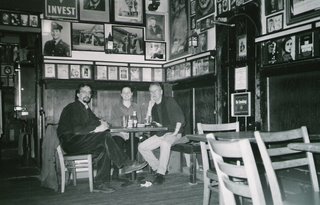
Chumley's, 86 Bedford: we arrived at 1 p.m. not knowing that it didn't open till later in the afternoon. This wasn't a problem for they didn't have signage let alone hours of operation posted. We just tried the door. It opened. We heard, oddly enough, British accented voices rising from the depth of the pub. We entered as if into another dimension, feeling like we just stepped out of the Tardis and were following Dr. Who into another adventure. We found ourselves amidst a large group of 17 year olds and a few middle-aged overseers. It turned out it was an F. Scott Fitzgerald literary tour for a public school from England and Chumley's had opened especially for them. We were just lucky. We sat down at a table and picked up what we thought was a menu but it was really a plastic folder providing the students with literary information on Fitzgerald et al. They did allow us to stay for my brother-in-law's British accent and natural charm paved the way with the British teachers and the pub manager. After all, it was a pilgrimage like theirs, and special for it was a Chumley in search of a Chumley. Well, figuratively. The portobello burger, fries and a beer set us right. We took photographs and browsed before leaving by what was originally the front entrance on Barrow Street and its fascinating courtyard, feeling the gods were looking kindly on us that day. We were entranced by Pamela Courtyard and the brick archway on 58 Barrow Street. In prohibition days, the owner, Leland Chumley would stall the police here while the patrons left by the exit at 86 Bedford. The euphemism "86 it" was in common parlance for many years as the code for "let's get out of here".
Street front anonymity hasn't hindered this unique meeting place. It's introverted character conceals a creative and imaginative extroverted joie de vivre. Most especially on a Friday night I imagine.

shadows and pathways


It was a Remedios Varo kind of day.

Friday, September 01, 2006

Badminton on the Beach

On The Beach
On the 19th of August, 1826, John Galt, novelist, poet, writer and business entrepreneur, along with his financial associates in London, England, were granted a charter for their corporation, The Canada Company, which eventually allowed them to purchase over a million acres in Upper Canada known as the Huron Tract, and they were granted this charter without any intimation that 180 years later my wife and I would be playing badminton on a white sandy beach along Lake Huron on the August Bank Holiday weekend.

They can be forgiven for this lack of foresight since badminton as we know it only truly developed in the 1860s, when British Army officers in India created a variation on the popular children's game Battledore and Shuttlecock by introducing a net and competition. The game was known as poona, from the city where the officers were stationed. However, in the year 1873, in the heart of sporting Gloucestershire, the Duke of Beaufort's country house saw many a military officer entertained, and one of their amusements was the playing of poona on the sumptuous grounds of the Duke's estate, Badminton House, and so the game was soon referred to as the "Badminton game," and then quite simply, badminton. Not far away in one of the oldest cities of Britain, the first badminton club was created, The Bath Badminton Club, 1877. Perhaps they inaugurated the opening with a taste of the medicinal waters which induced the Romans to settle there in A. D. 44 naming it Aquae Sulis after the Celtic goddess Sul.

As we casually played badminton on the beach, I thought of how the trajectories of the shuttlecock were similar to the trajectories that so entertained soldiers in India and on the Duke of Beaufort's estate, as well as the children playing battledore and shuttlecock on the streets of many an English village and city for hundreds of years. The trajectory of my own memories followed the shuttlecock, leading me back to recollections of holidays on Prince Edward Island playing badminton on Cavendish Beach as a youngster in the 1960s. The beach was not dissimilar; the scent of the dune grass and the rich marine essence in the air, the hot sun upon my arms, the warm sands beneath my feet, and the sound of the waves breaking upon the shore all helped to recreate a vivid recollection, and time seemed to have shifted forty years into the past. The trajectories of the shuttlecock revealed the rythyms of life in their novel patterns of flight, authors of parallel variations played out in our footprints in the sand.

Over The Horizon
I gazed and squinted, shaded by sunglasses, straw hat and the small colourful beach umbrella attached to the seemingly miniature beach chair in which I sat, my bare feet seeking out the cooler depths of the therapeutic sands. My wife beside me, likewise, reading, content. It was the distant horizon, however, that commanded my attention, the New York Times crossword having fallen to my lap, and the voices of our friends and family frolicking in the warm waters becoming part of the general chorus of holiday-makers carried on the breeze. The horizon is such a powerful symbolic line. An inspiration for the dynamics of change, of chance, of daydreams. I was that youth again, on that Prince Edward Island beach, staring out at the horizon, blue on blue, wondering where a straight line ahead would lead me. I had not learned that life rarely flows in a straight line, and I didn't know that many years later, I would be travelling the distant shores on the other side of that horizon, following the North Shore of the St. Lawrence River towards the Quebec/Labrador border where I would find myself having breakfast in the small Labrador town of L'anse au Loup on a foggy morning in the month of August.

It was the month of August in 1809 when the thirty year old John Galt found himself between landfall and departure at Gibraltar. Galt was on a business venture hoping to find ways to bring British trade goods to Europe via the Mediterranean to circumvent Napoleon's economic blockade. He was about to embark on a ship sailing to Sardinia, Malta and Greece and he had found refuge from the heat of Gibraltar by entering the library of the Military Garrison. As he sat reading, a younger man sat down beside him sighing heavily as if the weight of the world was upon him. Galt later wrote of him:

his dress indicated a Londoner of some fashion, partly by its neatness and simplicity with just so much of a peculiarity of style as seemed to show, that although he belonged to the order of metropolitan beaux, he was not altogether a common one.

He later caught sight of this uncommon young man aboard his ship bound for the wild Sardinian coast. It was, he learned, a young aristocrat named Lord Byron. Byron and his good friend John Cam Hobhouse, were travelling to the exotic Levant having been blocked on the overland route by the Napoleonic wars. Byron characteristically panned the overland Grand Tour route as nothing but "the common turnpike of coxcombs and virtuosos," justifying, no doubt, his forced trajectory via Portugal and Gibraltar. Little did John Galt realise as he gazed upon the horizon and hopeful promise of adventures gained, that he would publish a biography of Lord Byron twenty one years later based on his experiences sailing with the young poet.

I wonder though, did Byron forsee his own last horizon, when in September of 1809 he and Hobhouse sailed up from Greece to the then Albanian city of Preveasa passing the town of Missolonghi, remarking on its strange shoreline and the mountains rising into mystery beyond; a town where he was to die, helplessly and hopelessly, of fever in 1824 at the age of 36, the same year that Galt was busy writing to make money and busy with his plans for the Canada Company and the distant lands reaching the sandy shores of Lake Huron, where I sat with my wife enjoying the warmth of an August Bank Holiday, relaxing from our pleasurable exercise of badminton on the beach and ruminating on how life can be an enrichment of horizons with the promise of countless stories.

Thursday, August 24, 2006

Letters & Openings

In opening a letter today, my thoughts, enveloped in the folds of my self-concerns, returned to the city of my birth.
It was a special letter opener I used which brought my thoughts back to Montreal, for in the early 1990s, while living and working in lower Westmount, my interest in books led me out to garage and estate sales, and it was at one specific sale that I purchased a brown leather case enclosing a pair of scissors and a letter opener with celtic scroll work upon the handle. The garage sale was at the home of the Montreal writer William Weintraub. To me it was an immediate treasure and I imbued it with literary value, not only for its provenance, but for the fact that it may have been used to open letters from his good friends Mordecai Richler and Brian Moore.
In their brown leather case, they have acted as a paperweight upon my various desks over the years and a reminder of a certain literary backcloth to my life. In the late 1990s, while assigned to help set up literary readings at the library where I was employed, I received a letter from William Weintraub in response to a request of mine asking him to read in our series. It was a rather Nabokovian moment as I retrieved the letter opener from its sleek brown leather case to open his letter. There was a sense of being enveloped in a circle of inverted irony.
Even if the circle was a bubble of my own invention, it was still a connection, however tenuous, with the cosmopolitan writers who found their origin in the flowering of Montreal english-language writers in the 1950s and and 1960s. {It was a time of developments and new sensibilities with novelists and poets such as Louis Dudek, Irving Layton, A. M. Klein, F. R. Scott, Leonard Cohen, Hugh Hood and others. New publishers arose such as First Statement Press, Contact Press, Delta Canada, Harvest House Publishers, McGill University Press and Tundra Books.} It was another cosmopolitan writer, Mavis Gallant, who was the catalyst for the friendship of Weintraub, Richler and Moore. Brian Moore moved to Montreal in 1949 and began work at the Montreal Gazette where he worked with William Weintraub, and it was there he met his first wife through his fellow reporter. She too was a reporter but for the Montreal Standard and a friend of Mavis Gallant who was then living in Paris. When Moore and his wife took their honeymoon, they went to Paris and visited with Mavis Gallant and met up with William Weintraub who was freelancing in Italy. Mavis Gallant had met Mordecai Richler in Paris and she introduced him to Weintraub who in turn introduced him to Moore, and so their life-long friendships began. [This information can be found in Brian Moore: The Chameleon Novelist by Denis Sampson (Doubleday Canada, 1998).]

Mordecai Richler's The Apprenticeship of Duddy Kravitz (1959) and Brian Moore's The Luck of Ginger Coffey (1960) are like bookends to my Montreal literary imagination. They brought an urban reality and a renewed vigour to the written word. Belfast born Brian Moore lived in Montreal from 1949 to 1959 and was already living in New York when The Luck of Ginger Coffey was published, but he had penned nine other books during that period from 1951-1957, seven of them pulp fiction thrillers under various pseudonyms, so if he didn't find his voice in Montreal, he certainly developed it there. But it was Richler, born and bred in Montreal, who continued to set his stamp upon the city's literary imagination with great characters and novels from Noah Adler in Son of a Smaller Hero to Barney Panofsky in Barney's Version. Mordecai Richler was a writer in the grand sense of the word and his journalism will survive along side his fiction. His schimmelpenninck smoking man-of-the-world public persona during the 1980s and 1990s was exciting and enlivening. I always thought of him as our Canadian Anthony Burgess.
William Weintraub's memoir Getting Started includes letters from his good friends Richler, Moore and Gallant. A volume I keep on my desk for convenient pleasure, ready at hand for the right moment. A volume where I rest the sleek brown leather case with its scissors and letter opener with the celtic scroll work on the handle. An aide-memoire to my Montreal origins. And so life goes on.

Thursday, August 17, 2006

Boomerang Books : guest posting by Melanie

There is a strange phenomenon I have noticed with certain books. It is as if they want to belong to you; they can not be lost permanently. Lose them, try to give them away, they will return.
I've experienced two occasions of this happening. The first was the novel Volkswagen Blues by Québec author Jacques Poulin. I read it for a university class, and very uncharacteristically put my name inside the cover. Then I left it in one of the buildings at the university by mistake and it was gone. Three years later, now in a different university program and with different friends at a party, I struck up a conversation with a young man who as it turned out liked VW's. I mentioned this book as one he might enjoy; he said he had read it. Then he got a very funny look on his face and asked my name again. Turns out he had picked up my book three years previously and read it and given it to his father. His father sent it back to me. I still have it.
The second instance was a history of the Incas in Peru. I used it for a university class. Then I donated it to a library, where it was apparently sold in their booksale. At least three years later, I decided to study librarianship and began volunteering at this library. My supervisor was a slightly older man who I instantly had a crush on. Skip three years ahead; he and I are now a couple. I am browsing his bookshelves one day and what do I see? The same book, my old copy. We still have it.
I read the most startling instance of this in a letter to Victoria magazine from another second hand bookseller, some years ago. This bookseller had a small store in the US, and one day an older German woman came in. She browsed around, and after a while, the owner realized she had not seen her in quite some time. Upon searching around, she found her sitting in the children's book area in tears. She had a copy of Grimm's fairy tales in her hand, and explained that it was her own childhood copy, which she had left behind in the family home when they fled the Nazis approximately 60 years previously. Now there's a book which wanted to be found!

Thursday, August 10, 2006

Another day

Another day, another dollar. Literally. Such a day clears away illusions like a broom to cobwebs.

The ups and downs of business should help burnish the resilience of character. At least one hopes. However, I have known some old second-hand booksellers whose resilience of character may have been burnished to excess. Perhaps to the point of eccentricity. Such ups and downs are a challenge, but ones that should develop character. Or is it eccentric characters that they develop?

In leaving the stage of a bricks and mortar bookshop and shifting to the virtual privacy of selling books on-line, we may reduce the patina which seems to develop when exposed to many years of the second-hand book trade, but we will miss the people. That is the greatest enjoyment. Meeting interesting people and learning their stories in casual conversations. Though we will miss the direct human contact, the on-line relationships will be another facet to experience and we look forward to that challenge.
And so life goes on.

Tuesday, August 08, 2006

from O.O.P.s to P.I.P.s

A retired couple visited our book shop in Stratford, Ontario, on August 8th, and the husband enquired as to whether I had any Leonard Cohen books, or were they out of print. I assured him that Leonard Cohen's books were very much in print. In fact, I told him I had noticed a reprint trade paper edition of his first book, Let Us Compare Mythologies, in a window display of Fanfare Bookstore, one of the fine independent Stratford booksellers. (For the collector out there, the original publication, a McGill University Poetry Series Chapbook, is now worth a great deal in dollar terms. Though that is insignificant when compared with its poetic value.) I showed him my one remaining Leonard Cohen book, a selection of his poetry published by McClelland and Stewart . He had it already.
I have a hard time keeping Leonard Cohen books on the shelf. That is a good thing. A poet with perennial interest and appeal for both old and young is quite something. But Leonard Cohen is quite something. I wish I could avail myself of the phone and order a mixed box of Leonard Cohen's works but that is retail. I am in the second-hand trade. For me it is hunt and gather and hope for the best. A few weeks ago, a younger couple was in browsing. I recognized them as I do all my annual customers, with a touch of uncertainty. (Aging memory files take a bit longer to process when your customers only visit once a year. Such is the tourist town.) They had noticed a few works by Cohen a year ago but had not bought them. Of course they had been sold. That's the second-hand book trade, buy it when you see it. And today I put my last Leonard Cohen book in the window beside the selected correspondence of Jack McClelland, and yes, a woman came in and bought it like she had been expecting it to be there all the time. And tonight as I did a search for
Leonard Cohen on the Internet, I discover he is in Berlin for special concert events August 11-13, 2006.
August 8th is the eighth day of the eighth month, and the number 8 is one of the important numbers in Buddhism, and Leonard Cohen is well known for his interest in that spiritual path. Hey, it makes you think.
My first customer should never fear that Cohen's books will be out of print. And with sites such as
Project Gutenberg, which provide full-text on-line edtions for free viewing, there is a future cushion of internet immortality. Out of print books, what I call O.O.P.s, will become Perpetual In Prints, or P.I.P.s
And so life goes on.

Thursday, August 03, 2006

Desires and Fulfilments

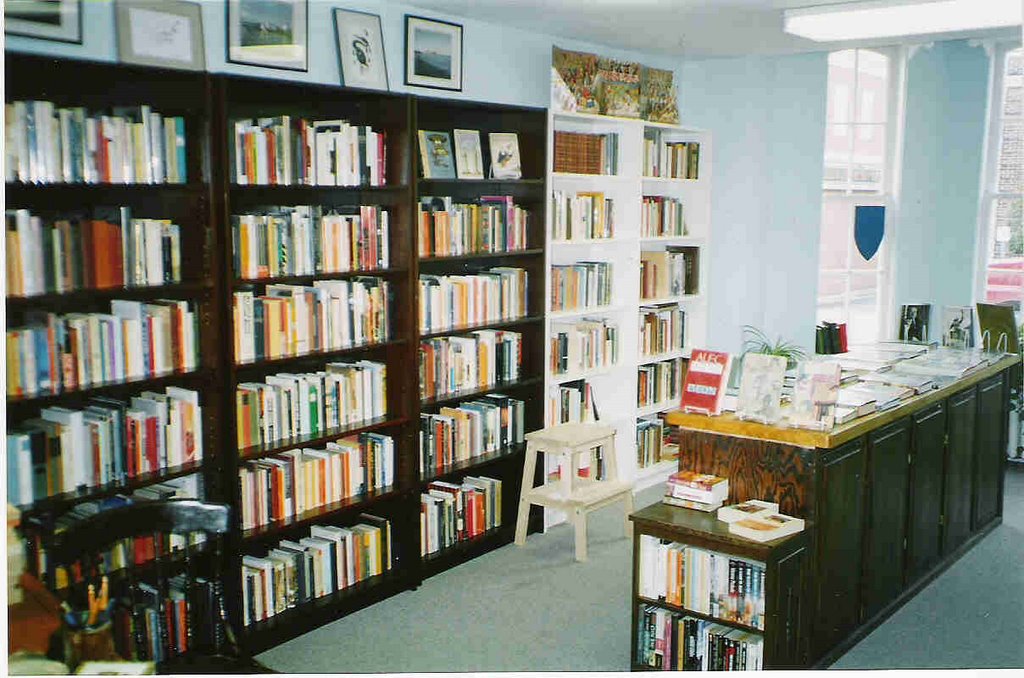
My wife and I have been running a bricks and mortar bookshop in beautiful Stratford, Ontario, Canada, for three years now. We named it Chumley & Pepys Second-hand Books after two cats. The cats were imaginary. They still are.
At the time we had a large handsome muscular orange tabby whose name was Cinnabar, an affectionate feline with a touch of human nature, and we didn't want to usurp his position with two upstart crows. (He never did know the shop was named after fictional replacements. He would have been indignant -- for a while anyway.) Cinnabar did, however, embody the characteristics of the imaginary cats, for there was a healthy portion of "Chumley" in him, and a touch of "Pepys" as well. Although Cinnabar has passed on, and his ashes reside in an urn nestled amongst books and plants with a window view, his replacements remain very much in the imaginary world. And so life goes on.

Both trained in librarianship and steeped in language, literature and books, we chose the names not only for their visual and sonorous qualities, but also for their literary references.
Chumley would seem less obvious, more obscure in its literary antecedents. Originally, and perhaps formally, it is spelled Cholmondeley. It is a name of a great English family who have been hereditary King's Chamberlain for over 200 years. The family seat in Cheshire,
Cholmondeley House, is well known for its gardens.
The authors who we had in mind are
Mary Cholmondeley and Alice Cholmondeley. Mary was a 19th Century writer who is best known today for her novel Red Pottage. Alice Cholmondeley was the pseudonym used by Elizabeth von Arnim for one novel, Christine. She wrote many novels under her own name and is best remembered for her book Elizabeth and her German Garden, and her novel Enchanted April, which was turned into an enchanting film.
The pronunciation of Cholmondeley as Chumley seems at first mystifying, but upon looking at word origins, one can see how pronunciations were changed over time, anglicized from their French or Anglo-Saxon origins. Interestingly enough, Elizabeth von Arnim's maiden name was Mary Anne Beauchamp, pronounced Beecham. It appears some families adapted the spelling to the pronunciation for simplification, and so one finds both Cholmondeleys and Chumleys, or Beauchamps and Beechams. The name Featherstonehaugh, pronounced Fanshawe, is but another example. A "haugh" is derived from Middle English, and refers to a flat piece of alluvial land near a river. How "featherstone" became "fans" would require more investigation. I leave that to your curiosity.
As for Pepys, pronounced Peeps, we of course refer to
Samuel Pepys (1633-1703), diarist, bookcollector, bon vivant, Secretary of the Admiralty, and President of the Royal Society. Not bad for a tailor's son. Pepys benefited from the patronage of his father's first cousin Edward Montagu (later to become the first Earl of Sandwich), and worked his way up from a lowly clerk with diligence and strength of character. This is revealed in his famous diary which he kept from January 1, 1660 to May 31, 1669. It is remarkable both for the insight into his own character and for the record of contemporary events and his involvement in them.
He was also a bibliophile. His personal library of 3,000 volumes was arranged by size, from No. 1 the smallest, to No. 3,000 the largest. It includes medieval manuscripts, incunabula, books relating to the navy, and his own diary in six volumes written in Shelton's shorthand. After the death of his nephew, John Jackson, the library, complete with bookpresses and library desk, was given to Pepys's alma mater,
Magdalene College, Cambridge where it now resides in a special room.
So, from that early desire many years ago, to have two cats named Chumley & Pepys one day, we did achieve their imaginary representation in the bookshop name and logo. We plan to shift our bookselling business on-line. Perhaps once we leave our bricks and mortar shop behind, we can bring the imaginary cats into present reality. A transposition and a fulfilment of desire. And so life goes on.