Sunday, February 18, 2007

Bookmarker: Special Number: Happy Chinese New Year

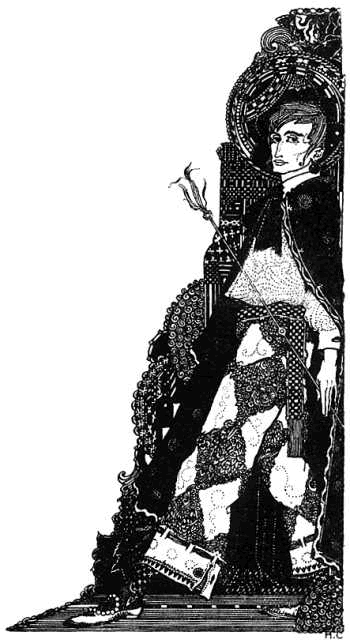
This delicate bookmarker depicts the extraordinary landscape of the Lijiang River with its unusual mountains rising up to the sky. The pagoda in the foreground seems to organically emerge from the rock in this aesthetic blend of man-made architecture and the wonders of nature. The Tang Dynasty author Han Yu, is often quoted when referring to this river:

The river is a beauteous winding ribbon,
The mountains are as emerald hairpins
.

This image may very well be an early depiction of the city Guilin, which translates as "the forest of sweet osmanthus." Certainly makes me want to reacquaint myself with Chinese history and description.


Friday, February 16, 2007

Bookmark of the Week: No. 1

Between the years 1910 and 1914 was the period that Insurance Companies began to advertise using bookmarkers. The Scottish Widows' Fund was originally conceived in an Edinburgh coffee house in 1812, and its object was to secure the financial stability of female relatives who lost loved ones in the Napoleonic wars. It was officially founded in 1815 and has continued to this day with marketing much removed from this rather classic and conservative bookmarker. Today, using a woman in a black cloak as the marketing image, the Scottish Widows' Fund is the most recognized brand of all the financial services in the UK. This seems to work most effectively as can be seen by the rather romantic, if not gothic photographs of the most recent advertising campaign with Hayley Hunt as the woman in black, and David Boni, photographer.

It is well known that Sir Walter Scott was one of the first investors, but what is less known, perhaps, is that a friend of his, a member of that extraordinary Clerk Maxwell family, also had a fairly important connection with the Scottish Widows' Fund. John Clerk, later Lord Eldin, was the son of James Clerk Maxwell's great uncle. He became a a well known and successful advocate and was instrumental in helping the SWF by serving on a committee which saw that the first bonus distribution of 1825 was made proportional and fair. The Scottish Widows' Fund and Life Assurance Society presented John Clerk with a gold snuff box in appreciation for his advice. Upon John Clerk's death, the snuff box came back to the Society and is now part of their much treasured, no doubt, archival history.

An unfortunate occurence, however, also connects John Clerk with the Scottish Widows' Fund. John Clerk was a connoisseur and collector of art and rare books, and upon his death his collection was sold. In fact it was sold in his very own house where close to 150 avid buyers crowded together for the chance at acquiring art work from his collection. So many people, in fact, that the floor collapsed killing a banker by the name of Mr. Alexander Smith. John Clerk's old friend, Mr. McKean, the Manager of the Scottish Widows' Fund, was also in attendance, but wisely chose to stand on the hearth stone. As it was left standing, so was he.
This bookmarker was designed by Walter Crane for the Society. These issues are fairly common and the amount of the funds provides a clue as to the year it may have been printed. This one is probably from the 1920s. Walter Crane designed a more collectible set of bookmarkers for the Society when he was commissioned to create one for each month of the year. These were issued between the years 1910 and 1912 I believe.


Tuesday, November 28, 2006

The Meaning of Night

We have been having English weather of late. The overcast grey and mild temperatures with a hint of moisture on the way. Quite far from the -30 degree weather people in western Canada are experiencing now. This weather, though drab and dreary, is rich in character, the kind of weather that an M. R. James short story or a Wilkie Collins novel evokes, or an Atkinson Grimshaw painting can depict. If one would like to curl up with a great victorian-like read, one might want to turn to the recently published novel, The Meaning of Night, by Michael Cox. Though the footnotes seem more obtrusive than necessary, the story and the writing is of enough interest to carry one through the 600 page plus novel. John Bayley in his review of Michael Cox's 1983 biography of M. R. James, M. R. James: An Informal Portrait (Oxford University Press), writes: "Among the many pleasures to be got from Michael Cox's excellent book is the sense of a vanished world. . .Cox's wholly admirable book is a treasure-house of vanished lore, atmosphere and personalities." This could equally be said of The Meaning of Night. A good holiday read to be sure.

Monday, November 06, 2006

Forty Eight

This afternoon I locked the door to Chumley and Pepys Secondhand Books at 48 Albert Street, Stratford, for the last time. I put two garbage bags out and handed the keys in to the owners of the building. It was a good feeling. We were ready to move on.

After two months of wretched weather, it was a glorious day. We finally had a taste of Indian summer with the sun shining benignly and the temperature reaching 14 degrees. Cats were enjoying the warmth and squirrels were nervously busy but with a lighter bounce to their hops. The river Avon's water level had been lowered for the winter and the flocks of Canada Geese looked rather perplexed. Yes, it was a good day for closure.

Last Friday, stressed and exhausted, my wife and I were busy with last minute packing of odds and ends. We were removing the contents of an old wooden filing cabinet I had brought with us from Montreal, business files, christmas decorations, old audio cassettes, and junk, when upon opening the second drawer we looked down to see two large wooden numbers, a 4 and an 8, which I had bought long ago and painted the store colours, blue and gold, but had never used on the exterior signage. Last Friday was my 48th birthday. We both smiled at each other and remarked on the coincidence of closing the 48 Albert Street Bookshop on my 48th birthday. We had been so busy, we never thought about it until those wooden numbers played their part. It was a deftly cut jig saw piece that fit right in place.

Thursday, November 02, 2006

c'est le paysage longtemps...


Dust motes and bare shelves, tired thoughts and diminshed energies; hard to think I shall close the door and never return. Today, after almost a week of packing and moving boxes of books, my resolve and my ability to rise to the required challenge were at their lowest ebb. It was at the close of day, the light fading into a steel november dusk, that I came across an old audio cassette which had fallen behind a cabinet. An audio cassette I had taped of an interview with Joseph Campbell in 1981. On the other side I had taped the countertenor Alfred Deller singing John Dowland's songs with Robert Spencer, lute, and the Consort of Six. Holding this old "Intermagnetics" 60 minute audio cassette, was like finding a lost thread of light directing me out of the of the bibliographic labyrinth I had entered three years ago. I sat on the weathered oriental carpet and my thoughts travelled back to conversations on philosophy, literature, art and music with a friend in the cafes of Montreal on la rue St. Denis and boulevard St. Laurent. The friend who lent me his old slightly scratchy album of Alfred Deller singing Dowland, and the one who told me of Joseph Campbells work. The days of haunting secondhand bookshops for Kierkegaard, Donne, Conrad or Durrell; and record shops in search of those Angel Records of Freni, Baker, or Schwarzkopf, or Blue Note Records of Miles Davis and other giants, or those ECM albums which were so in vogue...

At home, I showed my wife the cassette and we listened to it together. It was a pleasure to be able to share a part of my life of 25 years ago, but saddening, for the world seems to be running further away from the philosophical truths Campbell believed in.

At the beginning of the day, however, I turned on CBC radio as I usually do when I enter the shop, and the classical request show Here's to You with Shelley Solmes . She was introducing a piece of music requested by someone who said he had had a dream of listening to this piece of music with a friend, and so would like to hear it on the show. It was the villanesca by Granados from his Danzas Espanolas. Angela Hewitt on the piano. That alone was interesting. A dream of listening to a specific piece of music. With someone. Unusual. But what had me transfigured into a statue of apprehension was that the piece of music was important to me as well. In fact, last night I had rumaged through some old video-cassettes and discovered a film I had taped off the television, one of my favorite French films of the 80s, Peril en la Demeure(1985) with Richard Bohringer one of my favorite actors who also appears in Diva, another favorite film of the 80s. This piece of music by Granados traces a thematic thread through the film. I watched the movie and was reliving that late 1980s and early 1990s period of my life.

Coming to the end of one pursuit I seem to have been shown the past, as if the recent three year section of my life had just shifted into puzzle position, interlocked with past events to reveal a larger picture. A final piece for the middle panel of the triptych of my life. This makes me think of Bohringer again, playing an interesting character in the film Diva, working on a very large puzzle, listening to ambient music and finding that last piece.

C'est le paysage longtemps, c'est une cloche,
c'est du soir la delivrance si pure-;
mais tout cela en nous prepare l'approche
d'une nouvelle, d'une tendre figure...
Ainsi nous vivons dans un embarras tres etrange
entre l'arc lointain et la trop penetrante fleche:
entre le monde trop vague pour saisir l'ange
et Celle qui, par trop de presence, l'empeche.
-R. M. Rilke

Dans la multiple rencontre


Dans la multiple rencontre
Dans la multiple recontre
faisons a tout sa part,
afin que l'ordre se montre
parmi les propos du hasard.
Tout autour veut qu'on l'ecoute-,
ecoutons jusqu'au bout;
car le verger et la route
c'est toujours nous!
-R. M. Rilke

Sunday, October 29, 2006

Chumley's, New York, Pamela Courtyard Revisited


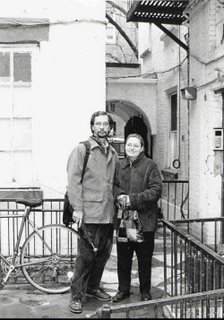
While making a card for my brother-in-law's birthday, I came across one of our scanned photographs which I had forgotten about. My wife and I are standing in Pamela Courtyard behind Chumley's looking towards the back entrance (and Brian my brother-in-law who is taking the photograph.) The brick archway rises behind us on Barrow Street. I kept looking at all the windows facing down on this courtyard, wondering who lived in these convenient dwellings, and what their stories were. Thinking too of all the writers, muscians and artists who have used this passageway on their way in, or out, of Chumley's.

Having just watched the Audrey Hepburn, Fred Astaire movie Funny Face, I can imagine Fred doing a neat dance number in the confines of Pamela Courtyard, using the wrought iron and the walls to create an acrobatic dance display. Is there an umbrella in it? Yes, I think so. In the movie Funny Face, there is a great dance number of Audrey Hepburn in a Parisian "beatnik" cafe, which reminded my wife of Mike Myers' funny routine of the sprockets on Saturday Night Live. Black turtle necks and all. Funny stuff. (Come to think of it, it also reminds me of his film So I Married an Axe Murderer, where he plays a poet who recites his works to jazz in a beatnik-like San Francisco cafe. More funny stuff. )

What has this to do with books? Well, Audrey Hepburn plays a clerk in a secondhand bookstore in New York, and the scenes in the bookshop are interesting for anyone who would like to slide down a room on a library ladder. We all need to dream.

Tuesday, October 24, 2006

A Macclesfield Mayor, a mysterious painting, and my love of books and art.


Recovering the past is to walk the labyrinth of inner thoughts. One hopes to find sources of meaning on the way in, and one hopes to discover sources of strength on the way out. My devotion to books has brought me great pleasures and much delight, but it is a devotion which comes with a literal weight. As I contemplate moving a bookshop, a small one though it is, I find myself overwhelmed with the thought of it. When I close my eyes I may be avoiding the task at hand, but I am really treading the maze-like path towards a recollection of the past in my search for the source of my love of books. And hopefully a source of strength on the way back.

The initial influence would be my Great Uncle, who inscribed his book gifts to us as "Uncle Ivan." He was my Mother's uncle who lived in the city of his birth, Macclesfield, England. My grandfather, Francis Herbert, was the only sibling of five brothers to emigrate. He, like his brother Ivan, was a talented amateur painter, and this was one of their common interests. The other, I believe, was to surround themselves with a few nice books. Some of my grandfather's books have passed down to me. Nothing truly old, rare or valuable, but valuable to me for their association and for his name inscribed on the occasional endpaper. These books would be the second influence. They used to reside on the top-most shelves of my parents bookcase, out of reach, thankfully, of a child's crayon world, abiding their time, silently awaiting the day when they could reveal their hidden magic. I remember standing on a chair, breathing in the heady odours released as I fanned their pages. I sometimes think that this is what hooked me on books. Their aesthetic, tactile and odiferous qualities. Ideas came later. Breathing an old book's scent can bring me back in time much like Proust's madeleine or the uneven paving stone. It can be ambrosial in nature. A relaxant for the mind. The third influence would be from an older cousin on my father's side of the family who gave us wonderful books for christmas presents. A set of four Joseph Conrad novels set me off on a life-long enjoyment of his works.

These influences reinforced each other to guide me along as a nacent book-fancier. Never having the money to buy from catalogues and such, I turned into a bookscout for my own desires. Church sales, garage sales, public library sales, and academic institute and university library sales were common sources. Invariably it meant lining up for long periods of time, often in inclement weather as most sales took place in the fall and the spring. These entailed competition and sweaty scrums. More enjoyable by far was browsing calmly in secondhand bookshops, each with their own charm, quality and selection. Some have long gone, buildings swept away for large plazas and downtown hotels, while others continue to thrive. I think how pleasant it would be to revisit my favorite Montreal bookshops. All booklovers have their stories and memories of bookshops and proprietors. Maybe some will even remember old Chumley & Pepys.

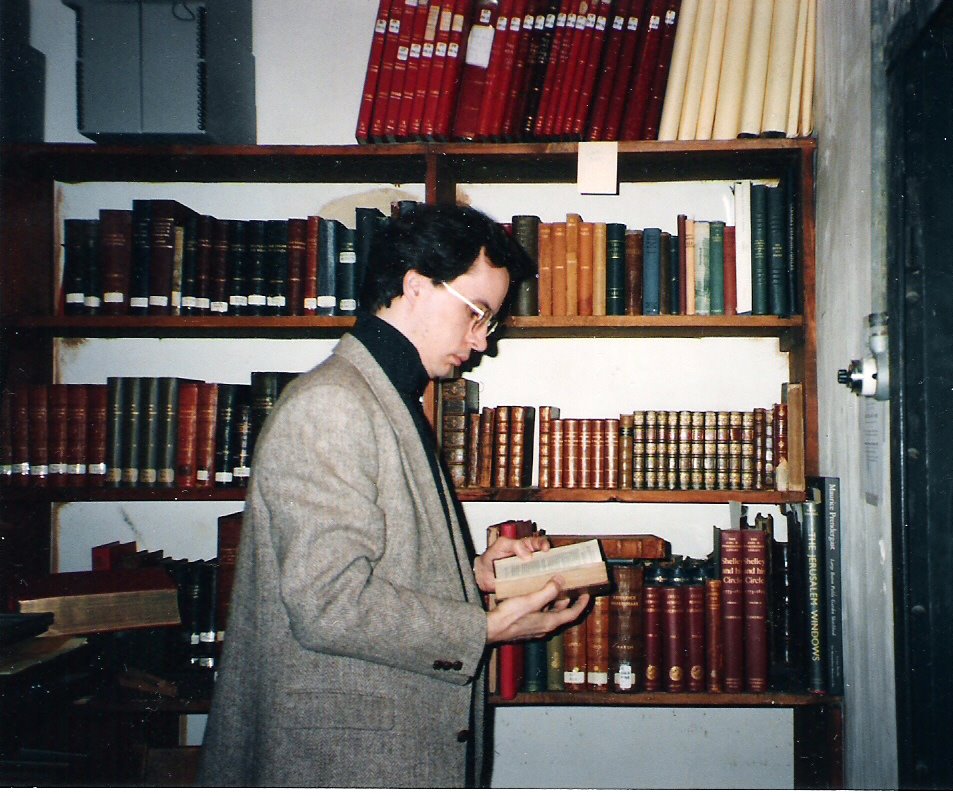
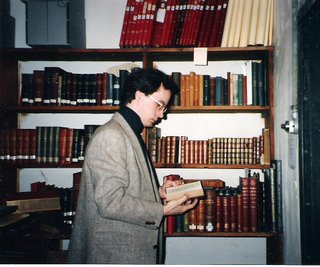
Books have led me on to work in a library and to pursue a library degree, which led me to the challenge of working on the archives of an old institute, and to the pleasure of cataloguing old books. The photo above captures me in my element, looking a bit younger and fresher, in the institute archives in 1992, perusing a volume of Montaigne's Essays. Probably his essai "On Books." I can see why Paul Theroux would like to carry a penguin paperback of Montaigne's Essays with him on his travels. It would be a good general companion.

These are my fancies, in which I make no attempt to convey information about things, only about myself. -Montaigne

What of the "Mayor" and the "mysterious painting?" Well, as I have said elsewhere, life rarely flows in a straight line, and so here too, in my meditation on my love of books, I recalled a story of my uncle Ivan. In his later years, before I was born, he finally paid a visit to Canada to see his brother Francis. Ivan was at the time the Mayor of Macclesfield, and so he brought one of his own paintings to present to the Mayor of Montreal, Camillien Houde. Houde had a checkered career but during the the 1939 Royal Visit, he seemed to have charmed the Queen and Prince Philip. At an official dinner, he sat beside the Royals and was reading a list. When asked what he was reading, he told Prince Philip that it was a list of subjects he was not to bring up and discuss with them. He passed the list to the Prince who responded with robust laughter. Nothing like honesty to break the ice. Supposedly the Queen thought him the most interesting of Mayors and said so when back in England. Perhaps this is what prompted my great uncle's gift. Good publicity. The fact is I have always wondered what became of this painting. Does it still reside somewhere in Montreal's City Hall? Was it stored away and later sold? Or did it stay with the Mayor's family? Perhaps there is a descendent of Mayor Houde who inherited this painting, and she or he is standing in front of it as this moment, whatever moment that is, wondering who the painter was and how it came to be in the family. This unresolved story is like one of the those distant pathways leading off into a misty valley. A pathway I have been meaning to follow. Perhaps when I revisit my favorite bookshops in Montreal, I could try to solve this question, and by solving it, discover another story to tell.

And what of the possible sources of strength to help me face the task at hand? Well, having traced my love of books to relatives, I must pause and think of their stories. A classic story of immigration, struggle and success; sons and brothers fighting in the second world war, persistence and hard work . . . . Moving a little bookshop is really nothing in comparison. So when I find myself bemoaning my sore back, I shall just think of my forebears and all they have strived for over the last century. That should give me perspective. And strength for that last box of books.


Tuesday, October 03, 2006

Pastoral delights for an urban night

Author photographs can be misleading. Some of them anyway. We have all seen the expensive professional photographs of famous popular writers such as Patricia Cornwell, Mary Higgins Clark and John Grisham for example taking up the complete back panel of the dustwrapper, where clothes, makeup and backgrounds exude success and wealth. Promotion to the tenth degree. But it is the lesser known literary authors who pose in front of books, brickwalls or funky decor where one is often on a more personal level. Perhaps too personal in some examples.
Then there is the disinclination to be photographed like Thomas Pynchon or Henry Green. The latter case was more understandable. It was for professional reasons. Henry Green had left Oxford without finishing his degree, some say it was because he didn't like his tutor C. S. Lewis, and began working for his father's company in Birmingham. When his first book came out, he didn't want employees and customers to recognize him as the author. Therefore a pseudonym and no photograph, or only one from the back. As for Pynchon, well, perhaps we could call it entropic paranoia.

When I was setting up literary readings for the library where I worked many years ago, I chose the poet and classics professor at McGill University, Anne Carson to read from her latest book. I was rather in awe of her accomplished learning and poetic achievement and found her dustjacket photo to be a formidable portrait. I had also been told that I would never get her and she was not very approachable. I had begun to build up a sense of her character based on these few observations and hearsay. She phoned me back to confirm that she would read, and when I asked her if there was anyone she would like to introduce her, she said she would ask her good friend and author, Will Aitken. He agreed and when the evening came round they arrived early and my wife and I chatted with them, I have to admit rather nervously. When we discussed how difficult it was to get people out to literary readings, she suggested wine and cheese. Wine and cheese. From a classics professor it seemed absolutely perfect. Will Aitken introduced her with a witty and well-crafted paragraph and Anne Carson then had us laughing with her extraordinary charm and wit. She was seemingly nothing like the person I had developed in my mind based on the photograph and her academic achievements and what I heard through the grape vine. How foolish I felt. Her sense of humour was wonderfully quirky and her poetry a delight. We began to offer wine and cheese at our literary readings and the two other independent libraries that I was setting up readings for also followed suit with positive results. Goes to show that if you get beyond the representation, there can be a bit of wine and cheese awaiting. A bit of pastoral delight for an urban night.

Monday, September 25, 2006

Chumley's New York Redux


During the first year of operating Chumley & Pepys Second-hand Books, a customer came in and asked if we had any connection to Chumley's in New York City. Nope. No connection. But six months later there we were.

My brother-in-law was in the production of King Lear starring Christopher Plummer that year in Stratford, and Christopher Plummer took it to the Lincoln Center over the winter. It was our opportunity to make the circle complete.

We travelled overland using our VIA points to the border, and enjoyed a train car with the ideal temperature and hot Red Rose Tea--"only in Canada, you say. Pity." Then it was tepid Lipton's Tea--don't they make soup?--and overheated train cars from Niagara Falls to New York City. Oh, well, it was cheaper than flying. We only had three full days in New York so we had to narrow the tourist possibilities to our specific interests: libraries, books, art, tea and Chumley's. Beside the performance of King Lear of which Christopher Plummer had me in tears again, we managed to squeeze The Brooklyn Bridge, Central Park, Time's Square, and a quick tour of Soho and the Village into our itinerary. New York is inexhaustible. Three days was just a taste, but enough to see the Cloisters, The Frick Museum, New York Public Library, Colliseum Books, Gotham Book Mart, The Strand Bookshop, as well as enjoying much needed sustenance at Alice's Tea Cup, Zen Palate and a great little Italian Bistro on Columbus.
Greenwich Village alone could easily take three days of exploration. So many writers and their fictional characters have lived in this literary and artistic neighbourhood: Thomas Wolfe, Djuna Barnes, e. e. cummings, Sherwood Anderson, Marianne Moore. The list could on and on. We passed 75 1/2 Bedford which is a very narrow red bricked building where Edna St. Vincent Millay lived for a short time. And it was along this stretch of sidewalk that Saul Bellow's Charlie Citrine walked on his way to visit Humboldt who lived on Bedford Street near Chumley's. Simone de Beauvoir found it to be a place conducive to writing, reading and good conversation. She said it had "atmosphere." I can't remember where I heard that F. Scott Fitzgerald and Zelda had their wedding reception at Chumley's. Probably from the same source who told me that the newlyweds had conceived their first child there. Sounds like hearsay. But then again. . . .
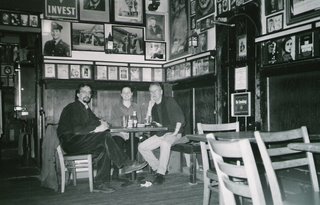
Chumley's, 86 Bedford: we arrived at 1 p.m. not knowing that it didn't open till later in the afternoon. This wasn't a problem for they didn't have signage let alone hours of operation posted. We just tried the door. It opened. We heard, oddly enough, British accented voices rising from the depth of the pub. We entered as if into another dimension, feeling like we just stepped out of the Tardis and were following Dr. Who into another adventure. We found ourselves amidst a large group of 17 year olds and a few middle-aged overseers. It turned out it was an F. Scott Fitzgerald literary tour for a public school from England and Chumley's had opened especially for them. We were just lucky. We sat down at a table and picked up what we thought was a menu but it was really a plastic folder providing the students with literary information on Fitzgerald et al. They did allow us to stay for my brother-in-law's British accent and natural charm paved the way with the British teachers and the pub manager. After all, it was a pilgrimage like theirs, and special for it was a Chumley in search of a Chumley. Well, figuratively. The portobello burger, fries and a beer set us right. We took photographs and browsed before leaving by what was originally the front entrance on Barrow Street and its fascinating courtyard, feeling the gods were looking kindly on us that day. We were entranced by Pamela Courtyard and the brick archway on 58 Barrow Street. In prohibition days, the owner, Leland Chumley would stall the police here while the patrons left by the exit at 86 Bedford. The euphemism "86 it" was in common parlance for many years as the code for "let's get out of here".
Street front anonymity hasn't hindered this unique meeting place. It's introverted character conceals a creative and imaginative extroverted joie de vivre. Most especially on a Friday night I imagine.

shadows and pathways


It was a Remedios Varo kind of day.

Friday, September 01, 2006

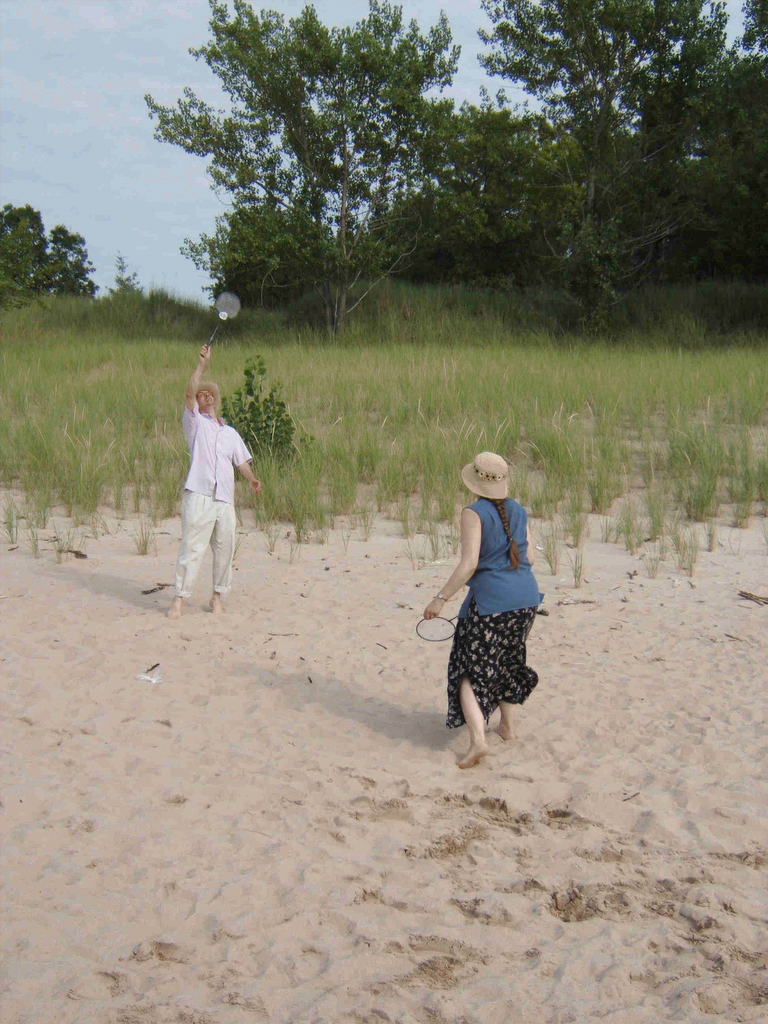
Badminton on the Beach

On The Beach
On the 19th of August, 1826, John Galt, novelist, poet, writer and business entrepreneur, along with his financial associates in London, England, were granted a charter for their corporation, The Canada Company, which eventually allowed them to purchase over a million acres in Upper Canada known as the Huron Tract, and they were granted this charter without any intimation that 180 years later my wife and I would be playing badminton on a white sandy beach along Lake Huron on the August Bank Holiday weekend.

They can be forgiven for this lack of foresight since badminton as we know it only truly developed in the 1860s, when British Army officers in India created a variation on the popular children's game Battledore and Shuttlecock by introducing a net and competition. The game was known as poona, from the city where the officers were stationed. However, in the year 1873, in the heart of sporting Gloucestershire, the Duke of Beaufort's country house saw many a military officer entertained, and one of their amusements was the playing of poona on the sumptuous grounds of the Duke's estate, Badminton House, and so the game was soon referred to as the "Badminton game," and then quite simply, badminton. Not far away in one of the oldest cities of Britain, the first badminton club was created, The Bath Badminton Club, 1877. Perhaps they inaugurated the opening with a taste of the medicinal waters which induced the Romans to settle there in A. D. 44 naming it Aquae Sulis after the Celtic goddess Sul.

As we casually played badminton on the beach, I thought of how the trajectories of the shuttlecock were similar to the trajectories that so entertained soldiers in India and on the Duke of Beaufort's estate, as well as the children playing battledore and shuttlecock on the streets of many an English village and city for hundreds of years. The trajectory of my own memories followed the shuttlecock, leading me back to recollections of holidays on Prince Edward Island playing badminton on Cavendish Beach as a youngster in the 1960s. The beach was not dissimilar; the scent of the dune grass and the rich marine essence in the air, the hot sun upon my arms, the warm sands beneath my feet, and the sound of the waves breaking upon the shore all helped to recreate a vivid recollection, and time seemed to have shifted forty years into the past. The trajectories of the shuttlecock revealed the rythyms of life in their novel patterns of flight, authors of parallel variations played out in our footprints in the sand.

Over The Horizon
I gazed and squinted, shaded by sunglasses, straw hat and the small colourful beach umbrella attached to the seemingly miniature beach chair in which I sat, my bare feet seeking out the cooler depths of the therapeutic sands. My wife beside me, likewise, reading, content. It was the distant horizon, however, that commanded my attention, the New York Times crossword having fallen to my lap, and the voices of our friends and family frolicking in the warm waters becoming part of the general chorus of holiday-makers carried on the breeze. The horizon is such a powerful symbolic line. An inspiration for the dynamics of change, of chance, of daydreams. I was that youth again, on that Prince Edward Island beach, staring out at the horizon, blue on blue, wondering where a straight line ahead would lead me. I had not learned that life rarely flows in a straight line, and I didn't know that many years later, I would be travelling the distant shores on the other side of that horizon, following the North Shore of the St. Lawrence River towards the Quebec/Labrador border where I would find myself having breakfast in the small Labrador town of L'anse au Loup on a foggy morning in the month of August.

It was the month of August in 1809 when the thirty year old John Galt found himself between landfall and departure at Gibraltar. Galt was on a business venture hoping to find ways to bring British trade goods to Europe via the Mediterranean to circumvent Napoleon's economic blockade. He was about to embark on a ship sailing to Sardinia, Malta and Greece and he had found refuge from the heat of Gibraltar by entering the library of the Military Garrison. As he sat reading, a younger man sat down beside him sighing heavily as if the weight of the world was upon him. Galt later wrote of him:

his dress indicated a Londoner of some fashion, partly by its neatness and simplicity with just so much of a peculiarity of style as seemed to show, that although he belonged to the order of metropolitan beaux, he was not altogether a common one.

He later caught sight of this uncommon young man aboard his ship bound for the wild Sardinian coast. It was, he learned, a young aristocrat named Lord Byron. Byron and his good friend John Cam Hobhouse, were travelling to the exotic Levant having been blocked on the overland route by the Napoleonic wars. Byron characteristically panned the overland Grand Tour route as nothing but "the common turnpike of coxcombs and virtuosos," justifying, no doubt, his forced trajectory via Portugal and Gibraltar. Little did John Galt realise as he gazed upon the horizon and hopeful promise of adventures gained, that he would publish a biography of Lord Byron twenty one years later based on his experiences sailing with the young poet.

I wonder though, did Byron forsee his own last horizon, when in September of 1809 he and Hobhouse sailed up from Greece to the then Albanian city of Preveasa passing the town of Missolonghi, remarking on its strange shoreline and the mountains rising into mystery beyond; a town where he was to die, helplessly and hopelessly, of fever in 1824 at the age of 36, the same year that Galt was busy writing to make money and busy with his plans for the Canada Company and the distant lands reaching the sandy shores of Lake Huron, where I sat with my wife enjoying the warmth of an August Bank Holiday, relaxing from our pleasurable exercise of badminton on the beach and ruminating on how life can be an enrichment of horizons with the promise of countless stories.